


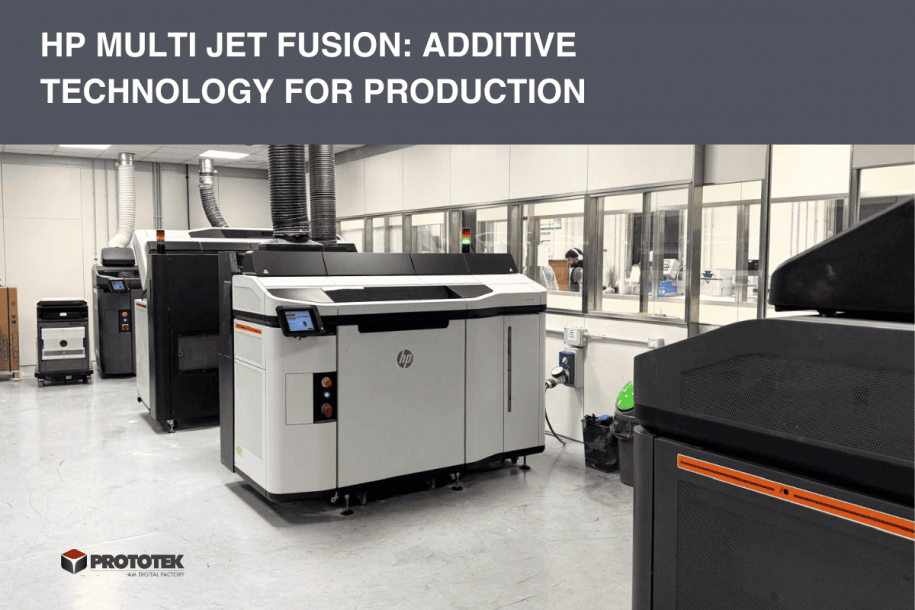
HP Multi Jet Fusion (MJF) has rapidly become one of the most adopted additive manufacturing technologies for industrial applications.
If you are an engineer, R&D manager, or product developer evaluating whether MJF is the right fit for your next project, this guide answers every critical question: from how it works and what materials it supports, to costs, design rules, and how it compares to SLS and FDM.
What is HP Multi Jet Fusion and How Does It Work?
HP Multi Jet Fusion is a powder-bed fusion process developed by HP Inc. Unlike Selective Laser Sintering (SLS), which uses a laser to fuse polymer powder point by point, MJF uses two chemical agents — a fusing agent and a detailing agent — that are inkjet-printed onto a powder bed. A broad infrared energy source then activates the fusing agent, selectively melting the powder layer by layer.
Key steps in the MJF process:
- A thin layer of polymer powder (typically PA12 or TPU) is spread across the build platform.
- Fusing agent is deposited where the part should solidify; detailing agent is deposited at boundaries to sharpen edges and control geometry.
- An infrared lamp passes over the layer, fusing the treated powder.
- The process repeats layer by layer until the build is complete.
- The part cake is cooled, de-powdered, and finished.
The result: isotropic mechanical properties, fine surface detail, and the ability to run full-bed nested builds, making MJF highly competitive for both prototyping and scalable production runs.
What Are the Main Differences Between MJF, SLS, and FDM?
This is one of the most searched questions among industrial buyers. Here is a direct, structured comparison.
| Feature | MJF | SLS | FDM |
|---|---|---|---|
| Energy source | Infrared + chemical agents | CO₂ laser | Heated extrusion nozzle |
| Main materials | PA 12, TPU, PA 11 | PA 12, PA 11, PEEK, glass-filled | PLA, ABS, PETG, Nylon, CF composites |
| Part isotropy | High (near-isotropic) | Moderate (slightly anisotropic Z) | Low (anisotropic, weak Z-axis) |
| Surface finish | Medium (grainy, gray) | Medium (slightly rougher) | Visible layer lines |
| Dimensional accuracy | ±0.3 mm up to 100 mm or ±0.3% | ±0.3 mm or 0.3% | ±0.5 mm or higher |
| Build speed | Fast (full bed, parallel) | Moderate | Slow (sequential) |
| Cost per part (medium batch) | Low-Medium | Medium | Low (desktop), Medium (industrial) |
| Scalability to production | High | Moderate | Low-Medium |
| Support structures needed | No (self-supporting) | No (self-supporting) | Yes |
Quick answer: MJF is faster, more isotropic, and more scalable than SLS for industrial polymer parts. FDM is accessible and cheap but not suited for functional, end-use industrial components in most demanding applications.
What Materials Can MJF Use?
MJF is currently optimized for a specific but growing range of polymer powders. The most industrially relevant are:
- PA 12 (Polyamide 12): The workhorse of MJF. Excellent mechanical properties, chemical resistance, dimensional stability. Ideal for functional prototypes and end-use parts. At Prototek, we run HP PA 12 as our primary MJF material, with full ISO 9001 quality certification.
- TPU (Thermoplastic Polyurethane): Flexible, impact-resistant, rubber-like. Used for seals, gaskets, wearables, grips, footwear components, and vibration dampeners.
- PA 12 Glass Beads (PA 12 GB): Higher stiffness and thermal resistance than standard PA 12; suited for dimensional reference parts and jigs.
Materials NOT compatible with MJF: High-performance polymers such as PEEK, ULTEM, or metal powders are not currently processable by MJF — for those applications, other technologies such as SLS (for PEEK) or metal AM are required.
| Material | Tensile Strength | Elongation at Break | Flexibility Indicators (Modulus/Hardness) |
|---|---|---|---|
| HP 3D High Reusability PA 12 | XY Axis: 48 MPa / 6960 psi Z Axis: 48 MPa / 6960 psi | XY Axis: 20% Z Axis: 15% | Tensile Modulus XY: 1700 MPa / 245 ksi Tensile Modulus Z: 1800 MPa / 260 ksi |
| ESTANE 3D TPU M88A | X Axis: 15 (10.5) MPa Z Axis: 8 (6.5) MPa | X Axis: 440 (185) % Z Axis: 125 (55) % | Hardness: 88 ± 3 Shore A (X and Z axes) |
| HP 3D High Reusability PA 12 Glass Beads | XY Axis: 30 MPa / 4350 psi Z Axis: 30 MPa / 4350 psi | XY Axis: 6.5% Z Axis: 6.5% | Described as a stiff material. Tensile Modulus XY: 2800 MPa / 406 ksi Tensile Modulus Z: 2900 MPa / 421 ksi |
How Does MJF Affect Part Isotropy Compared to SLS?
Isotropy is the ability of a material to exhibit the same mechanical properties in all directions — X, Y, and Z. For industrial end-use parts, this is critical.
MJF achieves near-isotropic parts because the fusing agent heats and bonds the entire cross-section of each layer uniformly, without the directional scanning pattern of a laser. In SLS, the laser traces paths that can introduce directional stress gradients, especially in the Z-axis.
Practical implication: With MJF, you can orient parts in the build chamber based purely on nesting efficiency, without sacrificing mechanical performance in any specific direction. This is a significant advantage in production scenarios.
What Industries Use MJF Technology?
HP Multi Jet Fusion technology has found adoption across a wide range of industrial sectors, including those Prototek serves every day:
- Automotive: Functional brackets, air ducts, cable routing clips, interior prototypes, jigs and fixtures
- Aerospace: Lightweight structural components, internal brackets, prototype assemblies
- Nautical: Marine-grade fittings, housings, custom mechanical parts
- Industrial machinery and automation: End-of-arm tooling, grippers, fixtures, housings, functional prototypes
- Medical devices and wearables: Custom orthoses, ergonomic handles, anatomically shaped components
- Packaging: Custom tooling, forming dies, product mockups.
What Are the Limitations of MJF for Industrial Use?
No technology is ideal for every scenario. MJF has known constraints to consider:
- Limited material palette: Compared to SLS or FDM, fewer certified polymer options are available
- Surface finish: Parts come out with a characteristic gray, slightly grainy surface (post-processing — dyeing, bead blasting, painting — can improve aesthetics)
- Color options: Native output is gray/black; full-color printing requires post-processing or HP’s Multi Jet Fusion Full Color systems (which use different materials and are less mechanically oriented)
- Part size: Maximum build volume varies by machine model; very large single-piece parts may require splitting
- Thermal distortion on very large flat parts: Warping can occur on large, thin, flat geometries. Design guidance and correct orientation mitigate this.
Is HP Multi Jet Fusion More Accurate Than SLS?
Both technologies achieve comparable dimensional accuracy in the ±0.3 mm or ±0.3% range for most industrial applications. MJF can have a slight edge in feature sharpness at boundaries, because the detailing agent actively suppresses sintering at edges.
In practice, accuracy differences are marginal between well-calibrated MJF and SLS systems.
What Is the Surface Finish of MJF Parts?
Straight out of the printer, HP Multi Jet Fusion (MJF) parts feature a distinctive raw gray color and a matte, slightly textured surface comparable to medium-grit sandpaper.
Available Post-Processing Options
To elevate both the functional and aesthetic quality of 3D printed components, several advanced finishing processes are available:
Micro bead blasting: Goes beyond standard treatment by reducing surface porosity and improving smoothness through a slightly abrasive process.
Impregnation coloring: Achieves a uniform black color by penetrating the first layers of the part, ensuring a stable and long-lasting coloration.
Shiny Black treatment: Combines black impregnation with micro-bead blasting to reduce surface roughness and opacity. The result is a glossy, scratch-resistant, embossed-like finish.
Graphite treatment: Creates a smooth, anti-scratch, metallic grey surface, representing one of the highest-quality finishes available.
Painting and coatings: Optional professional painting, including thorough surface preparation, to achieve a perfect aesthetic appearance suitable for end-use products.
Vapor Smoothing: A controlled chemical finishing process where exposure to regulated vapors partially melts and reflows the part’s external surface. It delivers a uniform, glossy, and refined finish that significantly reduces porosity while maintaining mechanical integrity.
Key Advantages: Eliminates surface roughness, seals porous structures (ideal for humid environments or fluid contact), improves mechanical strength by reducing stress points and micro-cracks, ensures superior hygiene and cleanability, and increases durability against wear, chemicals, and abrasion.
Available Finishing Levels:
Soft: A light treatment suitable for functional components or prototypes where dimensional precision must be preserved and minimal roughness reduction is required.
Medium: A balanced finish offering the ideal combination of visual improvement and mechanical accuracy. Recommended for visible parts, assemblies, housings, and ergonomic components.
Max: The highest level of smoothing, delivering a near injection-molded appearance with glossy, sealed surfaces. Perfect for end-use consumer products, premium prototypes, and parts ready for direct sale.
When Is MJF the Best Choice for Manufacturing?
HP Multi Jet Fusion is the optimal solution when:
- You need functional, end-use polymer parts — not just visual prototypes
- You require near-isotropic mechanical properties across all three axes
- You are producing medium-to-large batches (1–10,000+ parts) where cost efficiency matters
- Your design features complex geometry, internal channels, lattice structures, or undercuts
- You need fast turnaround — MJF builds are fast, and full beds can be nested efficiently
- You are working with PA 12 or TPU as primary materials
- Your project must move from prototype to production on the same technology, eliminating qualification re-work
Is MJF Cheaper Than SLS for Large Batches?
Yes, in most cases. Because MJF does not rely on a single-point laser (which limits throughput), and because full build volumes can be packed with parts efficiently (no wasted vertical space due to support structures), cost per part decreases significantly as batch size increases.
For production batches of 100–10,000 parts, MJF is typically 20–40% lower cost per unit than comparable SLS runs, depending on part geometry and machine utilization.
What Are the Lead Times for MJF vs SLS Production?
| Quantity | MJF typical lead time | SLS typical lead time |
|---|---|---|
| 1–5 prototypes | 2–4 business days | 3–5 business days |
| 50–500 parts | 5–10 business days | 7–14 business days |
| 1,000–10,000 parts | 2–4 weeks | 3–6 weeks |
At Prototek, we manage the entire workflow: from file validation and design-for-manufacturing feedback, to production, post-processing, and delivery — with dedicated technical support throughout.
Are MJF Parts Durable for End-Use Applications?
Yes. PA 12 MJF parts are routinely used in:
Automotive production tooling and jigs
End-of-arm tooling in automated assembly lines
Consumer products that face repeated mechanical stress.
Key durability data for PA 12 (MJF):
Tensile strength: 48 MPa for both XY and Z axes.
Elongation at break: 20% on the XY axis and 15% on the Z axis.
Heat deflection temperature: 175°C at 0.45 MPa.
Chemical resistance: Excellent chemical resistance to oils, greases, aliphatic hydrocarbons, and alkalies.
What Certifications Are Available for MJF Parts?
At Prototek, HP Multi Jet Fusion production is covered by:
- ISO 9001 — Quality Management System certification covering the entire production process
- ISO 27001 — Information Security Management System, protecting your design files and project data
Material datasheets and full traceability documentation are available upon request for regulated industries.
What Are the Environmental Considerations for MJF?
- Powder reuse rate: MJF allows re-use of unfused powder with typical refresh rates of 20–30% new powder, significantly reducing material waste vs FDM (which generates support waste) and SLS (similar refresh economics)
- No support structures: Zero material wasted on supports — a key sustainability advantage
- Energy efficiency: MJF’s broad-area infrared process is more energy-efficient per unit volume than laser-based point scanning.
Common Failures With MJF Parts and How to Avoid Them
| Issue | Likely Cause | Solution |
|---|---|---|
| Warping on flat parts | Thermal gradients in large thin sections | Orient parallel to X-Y plane for large flat parts; increase wall thickness to ≥1 mm |
| Closed holes | Diameter below 1 mm | Redesign to ≥1.5 mm (recommended 2 mm) or post-drill |
| Powder trapped inside hollow parts | No escape holes | Add ≥2 escape holes opposite each other, minimum 3.5 mm diameter (recommended 5 mm+) |
| Rough surface on cosmetic faces | As-built finish | Specify bead blast + dye in order |
| Dimensional deviation > ±0.3 mm | STL resolution error, material shrinkage (~2%), thermal effects | Export at 0.01 mm chord deviation; typical MJF tolerance is ±0.3 mm up to 100 mm, ±0.3% above 100 mm |
"Where Can I Find MJF Service Providers? How to Choose?"
When selecting an HP Multi Jet Fusion (MJF) service bureau, evaluate:
- Certifications (ISO 9001 minimum; ISO 27001 for IP-sensitive projects)
- In-house technical support — can they review your design and suggest improvements?
- Material range and machine fleet — multi-machine production capability for scalability
- Post-processing capabilities — finishing in-house vs outsourced
- Turnaround time guarantees
- References in your sector.
Prototek specializes in MJF (PA 12, TPU) and Carbon DLS, with demonstrated experience across automotive, footwear, fashion, aerospace, and industrial machinery sectors.
We offer technical consultation before any order — because a better-designed part is a better part.
Ready to Test HP Multi Jet Fusion for Your Next Project?
Whether you need a single functional prototype or a scalable production run, our team can review your files, advise on design optimization, and give you a fast quote.
Request a consultation with Our Experts
Prototek — Advanced 3D Printing Services | PA 12 MJF | TPU | Carbon DLS | ISO 9001 | ISO 27001 Trusted by Selle Italia, Filippi Boat, and leading manufacturers across Europe.