


Carbon 3D Printing DLS™
for Functional Industrial Parts

Advanced Digital Light Synthesis™ for high-performance additive manufacturing
Prototek provides professional Carbon 3D printing DLS™ services for the production of functional components requiring advanced mechanical properties, high-quality surfaces and complex geometries.
Based on Digital Light Synthesis™ technology, Carbon enables the production of rigid and elastomeric parts with performance characteristics comparable to traditional injection-moulded materials.
From functional prototypes to low-volume production, Prototek helps companies accelerate product development and manufacture advanced components without the need for tooling.
What is Carbon 3D Printing DLS™ Technology?
Carbon DLS™ (Digital Light Synthesis™) is an advanced additive manufacturing process that uses digital UV light projection and programmable liquid resins to create high-performance polymer parts. Unlike conventional resin 3D printing technologies, Carbon uses the CLIP™ (Continuous Liquid Interface Production) process, which builds components continuously rather than layer by layer.
This process enables:
- Consistent mechanical properties in all directions
- Smooth surface finishes
- Reduced layer-related weaknesses
- Production of functional parts suitable for real-world applications
After printing, Carbon materials undergo a thermal post-curing process that activates their final mechanical properties, creating durable components with performance closer to engineering thermoplastics.
Why Choose Carbon 3D Printing DLS™ ?
Carbon 3D DLS™ combines advanced materials, continuous production technology and design freedom to deliver functional parts with performance beyond traditional additive manufacturing processes.
Isotropic Mechanical Performance
The continuous photopolymerisation process produces parts with consistent mechanical properties in all directions, making Carbon DLS™ suitable for demanding functional applications.
High-Quality Surface Finish
Carbon parts achieve smooth surfaces and fine details directly from the printing process, reducing the need for extensive post-processing.
Engineering-Grade Materials
A wide range of rigid and elastomeric materials enables the production of components requiring high strength, durability, flexibility and long-term performance.
Complex Geometries and Design Freedom
Carbon DLS™ allows engineers to create complex structures, lightweight components and advanced designs that are difficult or impossible to manufacture with conventional methods.
Fast Development and Scalable Production
From functional prototypes to low-volume production, Carbon DLS™ helps reduce development cycles and accelerate time-to-market without tooling investment.
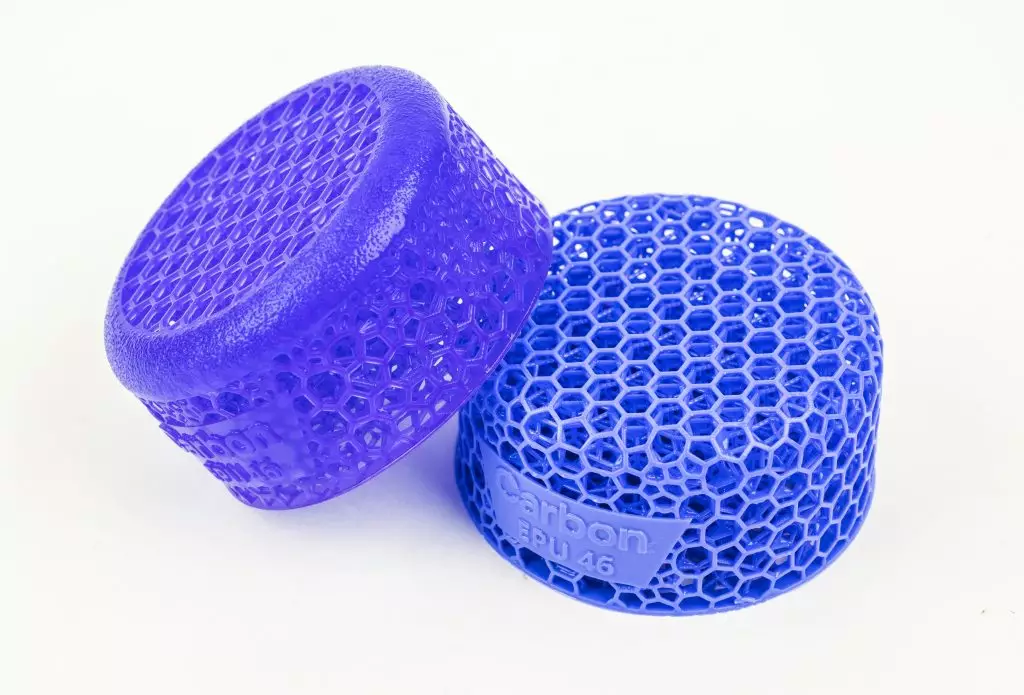
Advanced Design Possibilities with Carbon 3D DLS™
Carbon DLS™ enables the creation of customised mechanical behaviours through advanced lattice structures, allowing engineers to optimise:
- Variable stiffness and flexibility
- Energy return
- Impact absorption
- Weight reduction
- Ergonomic performance
Carbon 3D DLS™ Materials for Industrial Applications
Carbon 3D DLS™ offers a range of engineering-grade materials developed for functional prototypes, end-use parts and low-volume production.
Each resin is designed to provide specific mechanical properties, from rigid and impact-resistant components to flexible elastomeric parts with controlled elasticity and energy return.
Selecting the right material is essential to achieve the required performance in terms of stiffness, durability, temperature resistance and long-term reliability.
| Material | Main properties | Typical applications |
|---|---|---|
| Rigid Materials for Industrial Functional Components | ||
| EPX 82 (DLS) | High toughness, impact resistance and long-term durability | Structural components, functional parts, industrial applications |
| EPX 86FR (DLS) | Flame-retardant, strong and dimensionally stable | Electronics, transportation components, safety-critical applications |
| EPX 150 (DLS) | High temperature and chemical resistance | Components exposed to heat, chemicals and demanding environments |
| RPU 70 (DLS) | High strength, toughness and ductility | Housings, covers, functional mechanical components |
| RPU 130 (DLS) | High stiffness, toughness and thermal resistance | Durable industrial components and load-bearing parts |
| Carbon DLS™ Elastomers for Flexible Components | ||
| EPU 40 (DLS) | High elasticity, tear resistance and cushioning capability | Flexible components, impact absorption systems |
| EPU 41 (DLS) | High-performance elastomer with excellent energy return and fatigue resistance | Wearables, protective equipment, dynamic applications |
| EPU 43 (DLS) | Soft, durable and optimised for energy absorption | Padding systems, cushioning components |
| EPU 45 (DLS) | Excellent impact absorption under repeated deformation | Protective components, shock-absorbing applications |
| EPU 46 (DLS) | High energy return, adjustable stiffness and lattice compatibility | Sports equipment, ergonomic products, footwear components |
| Carbon DLS™ Materials for Rapid Prototyping | ||
| UMA 90 (DLS) | Fast printing, good rigidity and colour options | Design prototypes, functional prototypes, visual models |
| LOCTITE® 3D IND405 | Transparent, rigid and impact-resistant | Functional prototypes, transparent parts and validation models |
Need help selecting the right Carbon 3D DLS™ material?
Choosing the right resin is critical to achieving the required mechanical performance and production goals.
Our engineering team can help you identify the best Carbon material for your application.
Carbon DLS™ Applications for Functional Component
Carbon 3D Printing DLS™ enables the production of lightweight, high-performance components with customised mechanical properties and complex geometries.
The technology is widely used in industries where performance, design freedom and fast production are critical.
Automotive and Mobility
Carbon DLS™ supports the development and production of:
- Lightweight interior components
- Ergonomic components
- Flexible parts and vibration damping elements
- Functional prototypes for validation testing
Industrial Components
Suitable applications include:
- Covers and housings
- Technical supports
- Flexible components
- Seals and shock-absorbing elements
- Low-volume production parts
Wearables, Sports and Ergonomic Products
The combination of elastomeric materials and lattice structures enables:
- Protective equipment
- Technical padding
- Energy-return components
- Custom ergonomic solutions
Product Design and Consumer Applications
Carbon DLS™ provides designers with the freedom to create:
- Complex geometries
- Customised products
- High-quality aesthetic components
- Innovative functional designs
Functional Prototypes and Low-Volume Production
Carbon DLS™ is an effective solution for validating new products and starting production without tooling investment.
It allows companies to reduce development cycles, accelerate time-to-market and manufacture limited production runs economically.
Explore Carbon 3D DLS™ Applications
Discover how companies use Carbon technology to develop functional components and innovative products.
Carbon Lattice Structures: Engineering Custom Mechanical Performance with DfAM
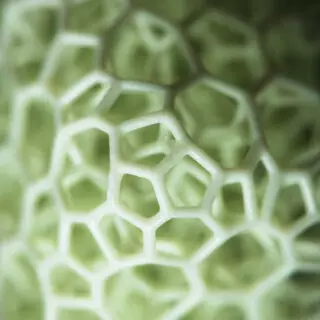
Design for Additive Manufacturing (DfAM)
One of the most powerful advantages of Carbon DLS™ is the ability to integrate lattice structures directly into components.
By controlling lattice geometry and density, engineers can customise:
- Stiffness
- Elasticity
- Weight reduction
- Energy absorption
- Comfort and ergonomics
Advanced design and simulation tools allow engineers to create optimised geometries that cannot be achieved with conventional manufacturing methods.
DfAM Engineering Support by Prototek
Prototek provides Design for Additive Manufacturing (DfAM) support to optimise customer CAD files for Carbon DLS™ production.
Our engineering approach helps improve:
- Print orientation
- Material efficiency
- Mechanical performance
- Component functionality
- Production reliability
By combining Carbon technology with DfAM expertise, Prototek helps transform complex concepts into functional industrial components.
Prototek: Your Carbon 3D DLS™ Manufacturing Partner
Prototek supports companies throughout the entire additive manufacturing workflow, from material selection and design optimisation to final production and finishing.
Our expertise includes:
- Carbon DLS™ material selection
- DfAM design optimisation
- Functional prototype development
- Low-volume and scalable production
With 7 Carbon DLS™ systems operating in-house, 24 hours a day, 5 days a week, Prototek can support production requirements ranging from individual prototypes to scalable manufacturing runs.
Depending on component geometry, material and application requirements, Carbon DLS™ can provide an economically viable alternative up to approximately 10,000 parts.
We also provide professional post-processing and finishing solutions, including surface treatments, colouring and aesthetic finishing.
How Carbon 3D DLS™ Technology Works
The Digital Light Synthesis™ process is based on Continuous Liquid Interface Production™ (CLIP™) and Carbon’s programmable liquid resins. CLIP™ utilizes digital light projection through an oxygen-permeable window, a concept first introduced in a groundbreaking Science journal publication.
Traditional resin 3D printing produces parts that are often brittle and prone to aging or crystallization. Carbon’s dual-component materials overcome this limitation: after the initial UV photopolymerization, a thermal post-cure chemically activates a secondary reaction that transforms the printed part into a true thermoplastic-equivalent structure.
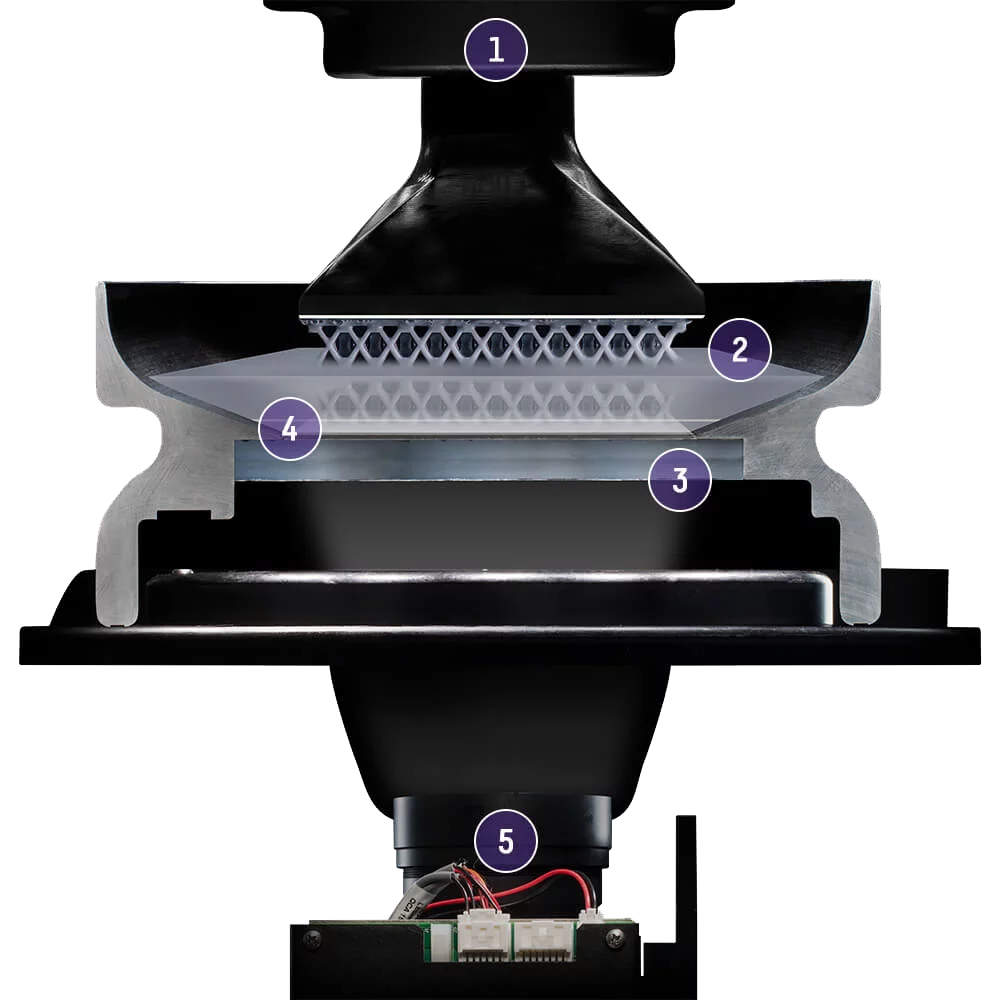
The CLIP™ Continuous Liquid Interface Production Process
CLIP™ is a photochemical process that uses UV light to solidify a specialized liquid resin. The UV image sequence is projected through an oxygen-permeable window beneath the resin tray, creating a continuous build zone where the part forms seamlessly.
Unlike conventional layer-by-layer DLP printing, CLIP™ continuously pulls the solid part upward, producing isotropic components with uniform density and no visible layer lines. This continuous process eliminates lateral stress during printing and allows faster, smoother, and stronger part creation.
Core Components of the System
- Build Platform
- Resin Vat
- Oxygen-Permeable Window
- Dead Zone (Continuous Build Interface)
- UV Light Engine and Motorized Lift System.
dead zone
The “dead zone” is key to the process; it’s the microscopic gap between the window and the part being printed.
This oxygen-rich zone prevents the resin from curing directly on the window, enabling constant resin flow and continuous printing.
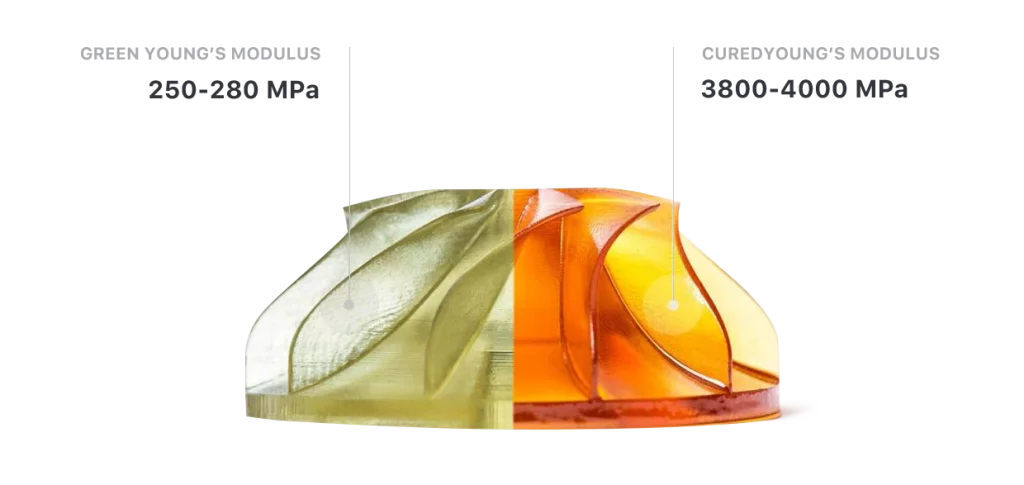
Thermal Activation: achieving true Thermoplastic Properties
At the end of the printing phase, the components are UV-cured and partially solidified. During the thermal post-cure, the second reactive component in Carbon’s resin activates, completing the polymerization and producing stable, strong, and durable parts.
This dual-stage curing process ensures outstanding mechanical performance, dimensional stability, and long-term resistance—qualities previously unachievable in resin-based 3D printing.
Exceptional Surface Quality and Mechanical Performance
Traditional resin 3D prints often suffer from weakness along the Z-axis due to their layer-by-layer construction.
The continuous build process guarantees:
Smooth, injection-mold-quality surface finishes
High accuracy and detail definition
Superior isotropy and durability
This makes Carbon 3D DLS™ ideal not only for prototypes but also for end-use industrial production.
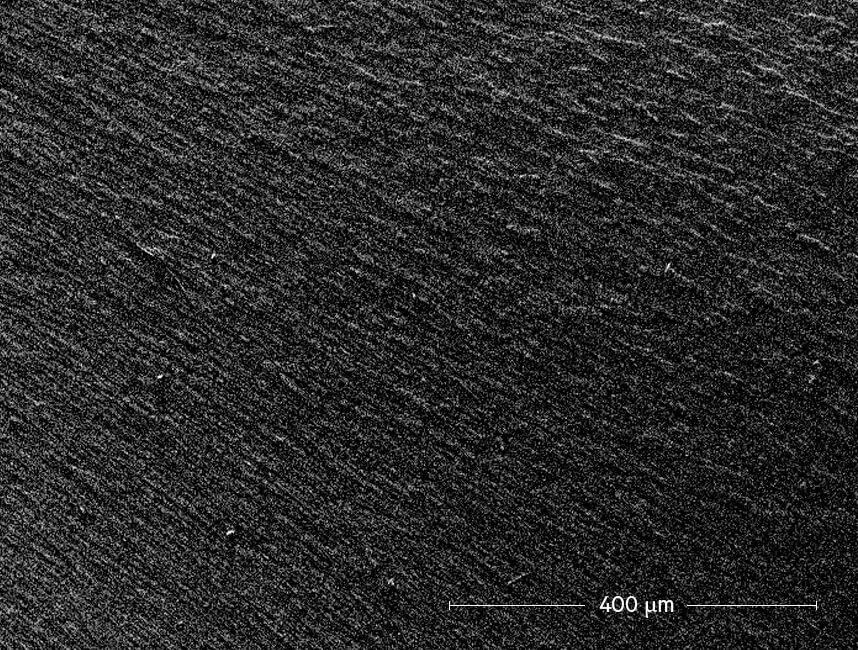
Digital Light Synthesis™
Carbon 3D DLS™ (Digital Light Synthesis™) produces isotropic parts with consistent density and strength in every direction.
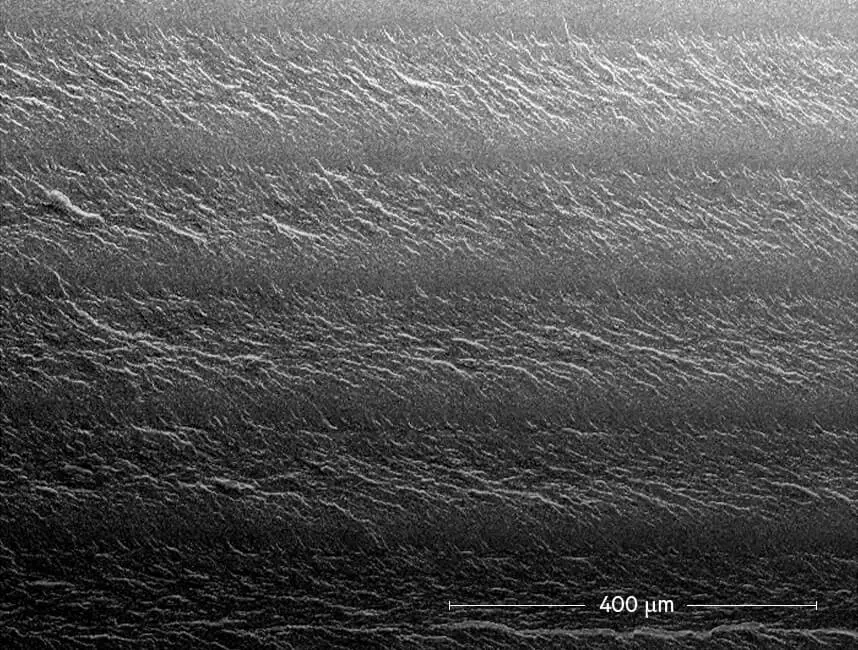
DLP 3D PRINTING
3D-printed parts are notoriously inconsistent. Their mechanical properties vary depending on the direction in which the parts were printed due to the layer-by-layer construction.
Carbon DLS™ vs Traditional Resin 3D Printing
Traditional resin technologies often show differences in mechanical properties depending on print direction.
Carbon DLS™ produces more uniform parts thanks to its continuous build process, enabling isotropic performance closer to injection-moulded components.