


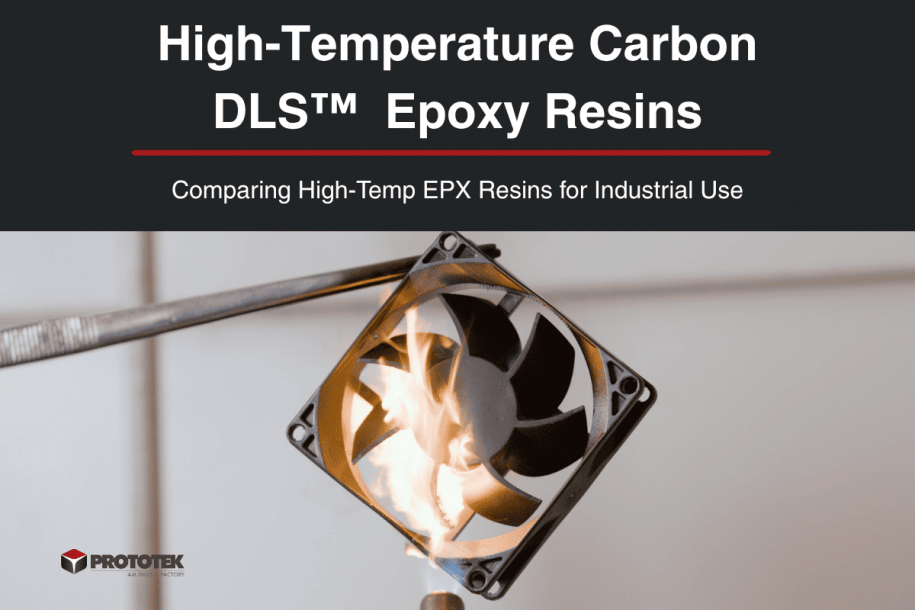
When an industrial component must withstand high temperatures, resist fuels and chemicals, and maintain dimensional stability under continuous load, standard polymers are not enough.
This article compares all three Carbon DLS™ epoxy resins across mechanical properties, temperature resistance, certifications, and application fit to help engineers and R&D teams select the right material for their project.
What Are Carbon DLS™ Epoxy Resins?
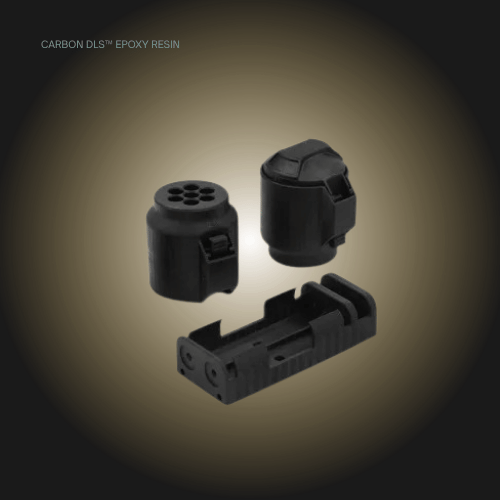
Carbon DLS™ epoxy resins — EPX 82, EPX 86FR, and EPX 150 — are engineering-grade materials designed specifically for demanding end-use applications in automotive, aerospace, medical, industrial automation, and high-performance manufacturing.
Carbon DLS™ (Digital Light Synthesis™) is a photopolymerization-based additive manufacturing process that uses UV light projected through an oxygen-permeable window to continuously cure liquid resin. Unlike layer-by-layer SLA or DLP systems, DLS™ produces parts with isotropic mechanical properties, meaning performance does not vary with print orientation.
This is the fundamental advantage of DLS™ epoxy resins over traditional AM materials: the part behaves the same regardless of how it was printed. For structural and load-bearing components, this is not a marginal improvement. It changes how the part can be designed and qualified.
At Prototek, EPX 82, EPX 86FR, and EPX 150 are all available in production, from single prototypes to series runs.
Carbon DLS™ Epoxy Resins: Technical Data Comparison
| Property | EPX 82 | EPX 86FR | EPX 150 |
|---|---|---|---|
| Tensile modulus | 2800 MPa | 3300 MPa | 2700–2900 MPa |
| Ultimate tensile strength | 80 MPa | 90 MPa | 76–79 MPa |
| HDT (dry, 0.455 MPa) | 130°C | 135°C | 155°C |
| Glass transition (Tg) | ~150°C | ~150°C | 175°C |
| Fire rating | UL 94 HB | UL 94 V-0 @ 2.0 mm / FAR 25.853(a) @ 1.0 mm | UL 94 HB |
| Biocompatibility | ISO 10993-5, 10993-10 | — | ISO 10993-5, 10993-10, 10993-23 + hemolysis |
| Autoclave sterilization | — | — | 430 cycles @ 134°C |
| USCAR2 automotive cycling | Yes | Yes (Class T3) | — |
| VIAQ (VOC, fogging) | Yes (3 ppm VOC) | — | Yes (<1 ppm VOC) |
EPX 82: High Mechanical Performance for Automotive and Industrial Parts
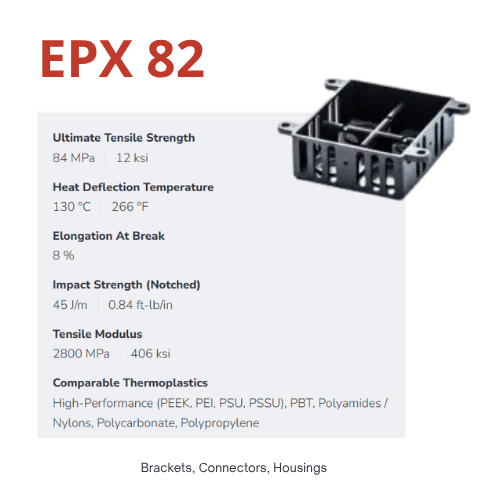
EPX 82 is a rigid epoxy resin for Carbon DLS™ that combines functional toughness, stiffness, and temperature resistance, making it highly useful for a variety of automotive, industrial, and consumer applications.
Key Mechanical Properties of EPX 82
Tensile modulus: 2800 MPa.
Ultimate tensile strength: 80 MPa.
HDT at 0.455 MPa (dry): 130°C.
Flexural modulus: 3000 MPa.
Elongation at break: 5%.
Shore D hardness: 89 (instant).
Chemical Resistance and Environmental Endurance
EPX 82 shows minimal mass gain (<5%) after exposure to engine oil, brake fluid (Castrol DOT-4), transmission fluid, diesel, engine coolant, and sulfuric acid (30%).
In USCAR2 automotive cycling tests (temperature/humidity, 240h), the tensile modulus retention is 95% and yield strength retention is 100%.
It passes automotive interior air quality standards, displaying a VOC of just 3 ppm against a target of <100 ppm.
It exhibits zero semi-volatile organics (FOG).
It demonstrates a fogging value of 0.04 mg against a target of <2 mg.
EPX 86FR: Flame-Retardant Carbon DLS™ Resin for Aerospace
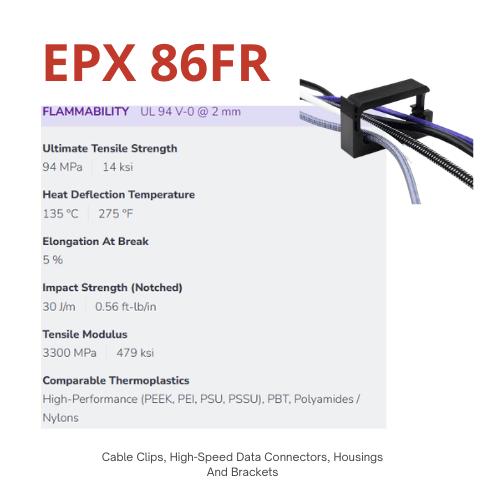
EPX 86FR is a fire-retardant variant that offers an unmatched combination of functional toughness, high strength, and long-term stability.
UL 94 V-0 and FAR 25.853(a) Fire Certifications
EPX 86FR exhibits self-extinguishing features.
In FAR 25.853(a) vertical burn testing at 1.0 mm thickness, the average flame time was 4.66 seconds.
During FAR 25.853(a) testing at 2.0 mm and 3.0 mm thicknesses, samples did not ignite at all.
The material achieves a UL 94 V-0 flammability rating at 2.0 mm and a V-1 rating at 1.5 mm.
High-Temperature Stability and Mechanical Data
Tensile modulus: 3300 MPa.
Ultimate tensile strength: 90 MPa.
HDT at 0.455 MPa (dry): 135°C.
Elongation at break: 5–10% (ISO 527 / ASTM D638).
It successfully withstands USCAR2 Class T3 (–40°C to +125°C, 40 cycles) thermal cycling with 100% retention of tensile modulus and yield strength.
Following heat aging at 125°C for 1000 hours, both the tensile modulus and ultimate tensile strength remain completely stable.
It shows excellent chemical resistance to industrial fluids, fuels, and solvents, recording <5% mass gain across all tested agents.
EPX 150: Extreme Temperature Resistance and Biocompatibility
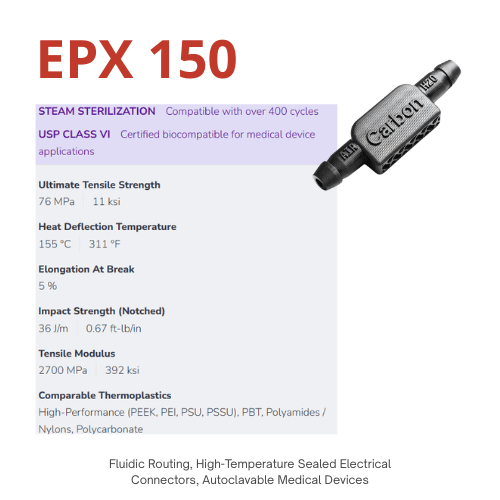
EPX 150 exhibits excellent chemical resistance, mechanical performance, is autoclavable, and is highly suitable for extended use at high temperatures.
Thermal Endurance and Autoclave Sterilization
HDT at 0.455 MPa (dry): 155°C.
Glass transition temperature (Tg): 175°C.
It demonstrates exceptional stability after 430 autoclave steam sterilization cycles at 134°C for 4 minutes.
After 3000 hours of heat aging at 125°C, the ultimate tensile strength and modulus remain unchanged.
After the same 3000-hour heat aging, the notched Izod impact strength retains >50% of its baseline.
Medical and Industrial Applications for EPX 150
It features comprehensive biocompatibility, passing ISO 10993-5 (cytotoxicity), ISO 10993-10 (sensitization), and ISO 10993-23 (irritation).
It also passes ASTM F756 / ISO 10993-4 for hemolysis and ISO 10993-11 for acute systemic toxicity.
Cytotoxicity requirements are met even after the material undergoes 430 autoclave sterilization cycles.
Tensile modulus: 2700–2900 MPa.
Ultimate tensile strength: 76–79 MPa.
It retains >80% of its tensile modulus, UTS, and elongation after 1000 hours of submersion in water at 85°C.
It shows an equivalent retention profile after 1000 hours of submersion in coolant/antifreeze mixtures at 85°C.
For RF and radome applications, it features a low, isotropic dielectric constant of 2.810.
How to Choose the Right Carbon DLS™ Epoxy Resin?
The three epoxy resins share the same DLS™ production process but answer different engineering requirements. Use this framework:
Choose EPX 82 if: you need strong structural rigidity, broad chemical resistance, and automotive qualification (VIAQ) for continuous operations up to 130°C.
Choose EPX 86FR if: your application requires fire certification (UL 94 V-0 or FAR 25.853) alongside thermal cycling performance up to 125°C. It is the stiffest of the three and the ideal option for aerospace fire-rated components.
Choose EPX 150 if: your application demands extreme temperature resistance (HDT 155°C), long-term fluid immersion stability, autoclave sterilizability, or comprehensive biocompatibility certifications for medical devices.
Additive Manufacturing vs. Injection Molding for Epoxy Components
For components in these material families, additive manufacturing is economically and technically competitive when:
Volume is below ~10,000 units: Tooling costs (typically very high per variant) do not need to be amortized.
Geometry includes complex features: DLS™ can easily produce undercuts, internal channels, and complex functional surfaces that are impossible or highly expensive to mold.
Design is subject to iteration: Each mold change in injection molding costs time and money; in DLS™, digital file adjustments cost nothing.
Lead time is critical: Moving from a validated CAD file to a finished part takes 1–3 weeks with DLS™, versus 8–16 weeks for tooled production.
Start Your Production with Prototek's Carbon DLS™ Service
Selecting the right resin is step one. Getting a production-ready part is a different challenge. At Prototek, we support your project from the first technical consultation:
Design for Additive Manufacturing (DfAM) analysis: We evaluate your CAD file and identify geometry optimizations before printing.
Material selection guidance: Matching the exact resin to your operating conditions, necessary certifications, and budget constraints.
Production planning: Scaling smoothly from functional prototype validation to series production.
Post-processing and QC: Managing surface finishing, dimensional verification, and batch certification.
ISO-certified processes: Guaranteeing quality management and full intellectual property protection across your entire manufacturing cycle.
Request a technical consultation
If you are evaluating Carbon DLS™ epoxy resins for a specific application—or comparing them to alternative materials or processes—our technical team is available for a direct consultation.
→ Send us your CAD file and project brief. We will provide a feasibility analysis, material recommendation and production proposal within 48–72 hours.
Send your Inquiry to Our Experts
Prototek — AM Digital Factory. ISO 9001 | ISO 27001 certified. Carbon DLS™ authorised production partner.