


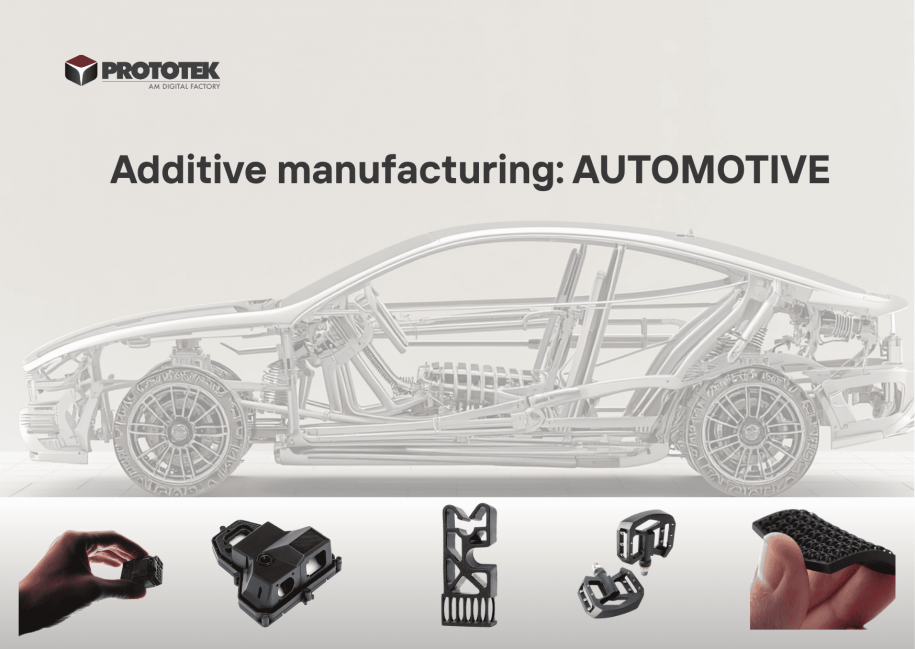
Additive manufacturing automotive: in this industry, it has moved well beyond prototyping labs.
Today, R&D teams and engineering departments across Europe use industrial 3d printing to produce functional prototypes, customized components, and small-to-mid series parts — without tooling investment, without minimum order quantities, and without compromising on mechanical performance.
From electronic housings to structural brackets, from aerodynamic components to custom interior parts: this article covers what is technically possible today, which materials and technologies are involved, and how leading automotive manufacturers are already integrating additive manufacturing into their production workflows.
Why Additive Manufacturing Has Become Strategic in Automotive?
The automotive sector has been among the earliest adopters of industrial 3D printing — and for good reason. Development cycles are long, the cost of late-stage design changes is high, and pressure on time-to-market is constant across all segments, from passenger vehicles to motorsport.
Additive manufacturing addresses three core engineering challenges:
- Faster iteration cycles: from CAD to physical part in 24–72 hours, with no tooling required
- Zero inventory pressure: produce only what is needed, when it is needed — eliminating warehouse stock entirely
- Unrestricted geometry: internal channels, undercuts, lattice structures, thin walls — geometries that injection moulding cannot replicate.
The scale of adoption speaks for itself. The BMW Group alone has installed over one million additively manufactured components in the past decade, with a 42% year-on-year increase in output recorded by its dedicated additive manufacturing division — and the trend shows no sign of slowing.
Across the industry, Additive manufacturing has shifted from a prototyping tool to a standard production resource, driven by faster technology cycles, broader material availability, and increasing pressure on time-to-market.
What Gets Produced with Additive Manufacturing in Automotive?
Functional Prototypes and Engineering Validation
Before a component enters production, it must pass functional testing, assembly verification, and engineering sign-off. Additive manufacturing makes it possible to:
Produce dimensionally accurate prototypes for fit & function checks
Iterate rapidly between design versions without retooling costs
Deliver physical samples to engineering teams on sprint-compatible timelines
Dimensional accuracy from HP Multi Jet Fusion and Carbon DLS™ ensures every prototype is fully representative of the final component — not an aesthetic approximation.
Jigs, Fixtures, and Production Tooling
One of the highest-ROI applications in automotive — and one of the most underestimated — is the production of auxiliary manufacturing equipment:
Custom assembly fixtures designed around specific part geometries
Quality control gauges for dimensional inspection
Ergonomic operator supports tailored to individual workers (BMW, for example, uses additively manufactured hand supports on assembly lines to reduce thumb strain).
These tools can be updated rapidly, adapted to new vehicle variants, and produced on demand — eliminating the long lead times of conventional machining.
Series Production: Small and Medium Volumes
When volumes do not justify injection mould tooling — or when geometry is too complex — Additive manufacturing automotive becomes the most efficient production route:
Window guides, interior supports, air ducts, electronic covers
Limited-edition or custom vehicle components
On-demand spare parts with immediate availability, no physical stock required
BMW i8 window guides have been produced in HP Multi Jet Fusion at a rate of 100 parts in under 24 hours, with consistent and documentable quality — a production benchmark that traditional methods cannot match at this volume.
Materials for Additive Manufacturing Automotive: Verified Technical Data
Material selection is decisive. At Prototek, we work with certified materials across two technology platforms — HP Multi Jet Fusion and Carbon DLS™ — covering the full spectrum of automotive requirements.
PA 12 — HP Multi Jet Fusion
The reference thermoplastic for functional series components in automotive applications.
Typical applications: electronic housings, connectors, ducts, interior components, complex assemblies, supports.
Key properties:
Excellent chemical resistance to oils, greases, aliphatic hydrocarbons and alkalis
High part density with balanced production cycles
Precise dimensional detail: small holes, thin walls, bosses
Industry-leading powder reusability (20% refresh rate)
Compatible with post-finishing processes: painting, metallisation
| Property (Nylon PA12) | Value |
|---|---|
| Density of parts | 1.01 g/cm³ |
| Powder melting point (DSC) | 187 °C |
| Tensile Strength, Max Load (XY & Z) | 48 MPa |
| Tensile Modulus (XY) | 1700 MPa |
| Tensile Modulus (Z) | 1800 MPa |
| Elongation at Break (XY) | 20% |
| Elongation at Break (Z) | 15% |
| Heat Deflection Temp (@ 0.45 MPa) - Z | 175 °C |
| Heat Deflection Temp (@ 1.82 MPa) - Z | 95 °C |
TPU (Estane® 3D M88A) — HP Multi Jet Fusion
Flexible thermoplastic polyurethane for components requiring elastomeric behavior.
Typical applications: seals, grommets, anti-vibration isolators, protective covers, flexible retention elements.| Property (TPU M88A) | Value |
|---|---|
| Hardness (Shore A) | 88 |
| Tensile Strength | 22 MPa |
| Elongation at Break | > 500% |
| Tear Strength | 65 kN/m |
Carbon DLS™ (Digital Light Synthesis™) produces parts with isotropic mechanical properties, high-quality surfaces, and complex internal geometries, not achievable with powder bed technologies.
EPX 82 — Structural Epoxy Resin
Combines functional toughness, stiffness, and temperature resistance. Suitable for a wide range of automotive, industrial and consumer applications.
Typical applications:
Structural functional prototypes, brackets, air ducts, supports exposed to continuous mechanical stress, and components operating in moderately demanding thermal environments.
| Property (EPX 82) | Value |
|---|---|
| Tensile Strength | 82 MPa |
| Tensile Modulus | 2800 MPa |
| Elongation at Break | 5% |
| Heat Deflection Temp (HDT @ 0.45 MPa) | 125 °C |
EPX 86 FR — Flame-Retardant Epoxy Resin
Unique combination of flame retardance, functional toughness, high strength, and long-term stability. Certified UL 94 V-0 and FAR 25.853(a).
Typical applications: components near electrical systems, cabin interior parts, any application requiring flame-retardant certification.
| Property (EPX 86FR) | Value |
|---|---|
| Tensile Strength | 86 MPa |
| Tensile Modulus | 3000 MPa |
| Elongation at Break | 5.5% |
| Heat Deflection Temp (HDT @ 0.45 MPa) | 135 °C |
| Flammability Rating | V-0 (UL94) |
RPU 130 — High-Performance Impact-Resistant Polyurethane
Strong and tough engineering polyurethane with a unique combination of durability, impact resistance, and elevated temperature performance.
Typical applications: impact-critical components, functional parts requiring high toughness at elevated temperatures.
| Property (RPU 130) | Value |
|---|---|
| Tensile Strength | 65 MPa |
| Tensile Modulus | 1800 MPa |
| Elongation at Break | 10% |
| Heat Deflection Temp (HDT @ 0.45 MPa) | 119 °C |
Elastomeric Resins — Carbon DLS™
For flexible, shock-absorbing applications in Additive manufacturing for automotive.
EPU 40 — High-Elasticity Elastomer
High-performance polyurethane elastomer for applications requiring high elasticity and tear resistance.
| Property (EPU 40) | Value |
|---|---|
| Hardness (Shore A) | 64 |
| Tensile Strength | 9 MPa |
| Elongation at Break | > 250% |
| Tear Strength | 20 kN/m |
EPU 41 — High-Resilience Lattice Elastomer
Production-grade elastomeric material especially suited for elastomeric lattices where high resiliency is needed.
| Property (EPU 41) | Value |
|---|---|
| Hardness (Shore A) | 70 |
| Tensile Strength | 11 MPa |
| Elongation at Break | > 130% |
| Tear Strength | 20 kN/m |
| Rebound Resilience | 62% |
EPU 43 — Energy-Damping Elastomer for High-Cycle Fatigue
Soft elastomer with good energy damping and excellent durability under high-cycle flexing.
| Property (EPU 43) | Value |
|---|---|
| Hardness (Shore A) | 71 |
| Tensile Strength | 15 MPa |
| Elongation at Break | > 200% |
| Tear Strength | 24 kN/m |
EPU 45 — Exceptional Energy-Damping Elastomer
Energy-damping elastomer with exceptional damping performance and optimised printability.
| Property (EPU 45) | Value |
|---|---|
| Hardness (Shore A) | 62 |
| Tensile Strength | 18 MPa |
| Elongation at Break | > 250% |
| Tear Strength | 30 kN/m |
EPU 46 — Bio-Based Elastomer (40% Biobased Content)
Flexible polyurethane resin, with high energy-return, offering colour and stiffness customisation, with 40% biobased content. Available in Black, Color Base, Soft and Extra Soft variants.
Note: EPU 46 stiffness is adjustable through the A:B ratio. Contact Prototek to select the most suitable variant for your application.
Typical elastomeric applications in automotive: high-performance seals, damping pads, ergonomic inserts, fatigue-cycled gaskets, lattice structures for lightweight impact absorption.
| Property (EPU 46) | Value |
|---|---|
| Hardness (Shore A) | 56-78 |
| Tensile Strength | 14 MPa |
| Elongation at Break | > 220% |
| Tear Strength | 22 kN/m |
Case Study: BMW GroupAdditive Manufacturing Automotive as an Industrial Standard
The BMW Group is one of the most extensively documented examples of the integration of systematic Additive manufacturing automotive at an industrial scale. Today, the Group produces more than 400,000 parts a year worldwide through additive manufacturing, with over 1.6 million parts produced since the launch of its Additive Manufacturing Campus in Oberschleißheim in 2020.
Mini Yours Customised
In 2019, through the Mini Yours Customised programme, BMW brought additive manufacturing automotive directly to the end customer: side indicators, dashboard trims, and illuminated door sills — all personalised to individual buyer specifications. A business model that conventional production could never have supported at this cost and lead time. BMW received the German Innovation Award Gold for this project.
BMW i8 — Window Guides in HP Multi Jet Fusion
For the i8, BMW adopted HP Multi Jet Fusion for series production of window guides: 100 components produced in under 24 hours, with consistent quality and a per-part cost competitive with conventional manufacturing.
Ergonomic Operator Supports
Custom hand supports — modelled on each assembly worker’s individual hand morphology — reduce thumb strain during repetitive operations on the production line. Each device is shaped around the specific worker. Impossible to replicate with any other production method.
Case Study: Confederate Motors (now Combat Motors)
Founded in 1991 with the ambition of building unmistakably rebellious motorcycles, Confederate Motors designed and produced exclusive bikes in small batches for over 25 years. The company has since undergone a significant evolution — giving rise to Curtiss Motorcycle Company and continuing its combustion legacy under the name Combat Motors — but its engineering pioneering spirit remains intact.
The introduction of additive manufacturing into the production workflow allowed the company to cut development times and production costs dramatically.
- Technology partnership: The project was built around stereolithography technology by 3D Systems — since evolved into what is now considered its natural successor, Carbon DLS™ — which accelerated product development and ensured the highest quality across all produced models.
- The P51 Combat Fighter: Critical structural components — frame, steering, and swingarm — were all produced using additive manufacturing. Moulds for carbon fibre parts (front and rear mudguards, exhaust filter, chain guard) were realised using Accura PEAK material.
“3D Systems allows us to design exceptional shapes and moulds from solid materials. The machines are so precise that the changes required between prototype and production are minimal. We only had to make a few adjustments to the project.” — Jordan Cornille, designer at Confederate Motors
How Prototek Works with Automotive Companies
Prototek is not a bureau that receives files and prints. Our value is in integrated technical consulting — accompanying every project from initial analysis through to final part delivery.
Our process:
- Project analysis — we evaluate geometry, optimal material, best-fit technology, and required tolerances
- DfAM (Design for Additive Manufacturing) — where relevant, we propose geometric optimisations to improve printed part performance
- Certified production — we operate under ISO 9001 for quality management and ISO 27001 for project data security
- Full scalability — from a single prototype to thousands of parts, with the same technical partner throughout
For recurring production needs, we also manage just-in-time logistics, eliminating the need for physical stock entirely.
Frequently Asked Questions
1. Which materials are certified for automotive use?
Thermoplastics, like nylon PA 12 and TPU processed with HP MJF, and Carbon DLS™ rigid/epoxy and polyurethane resins (EPX 82, EPX 86 FR, EPX 150, RPU 70, RPU 130 for rigid applications; EPU 40, EPU 41, EPU 43, EPU 45, EPU 46 for elastomeric applications) all come with certified technical datasheets and documented mechanical properties tested to ASTM and ISO standards.
2. Can additive manufacturing replace injection moulding in automotive?
For volumes from 1 to several thousand parts, and for complex geometries, additive manufacturing is often more cost-effective — injection moulding requires expensive tooling that must be amortised over large volumes. For high-volume standardised series, the two methods complement each other.
3. How is dimensional repeatability guaranteed across batches?
HP MJF and Carbon DLS™ technologies deliver tight, repeatable dimensional tolerances. Our ISO 9001-certified quality system includes systematic, documented dimensional inspection for every production batch.
4. How long from CAD file to physical part?
For PA 12 or TPU MJF parts: 24 to 72 hours standard production. For Carbon DLS™ resin components: 48 to 96 hours, depending on complexity. For serial production, we agree on a tailored delivery schedule.
5. How does Prototek handle project confidentiality?
We are ISO 27001 certified — the international standard for information security management. Every project is handled with full confidentiality.
6. Does Prototek ship to other European countries?
Yes. Prototek ships throughout Europe. Lead times and logistics are agreed on a per-project basis. Contact us to discuss your requirements.
Start with a Pilot Project in Additive Manufacturing Automotive
Additive manufacturing offers measurable advantages at every stage of the automotive development cycle — from functional prototyping to on-demand series production. HP Multi Jet Fusion and Carbon DLS™, combined with certified materials and verified technical data, make it possible to produce automotive-grade components with the performance the industry demands.
Contact the Prototek team for a no-obligation technical consultation. We analyse your requirements and propose the right material, technology and volume strategy for your project.
Prototek is a professional 3D printing service certified ISO 9001 and ISO 27001. Technologies: HP Multi Jet Fusion (PA 12, TPU), Carbon DLS™ (EPX 82, EPX 86 FR, EPX 150, RPU 70, RPU 130, EPU 40, EPU 41, EPU 43, EPU 45, EPU 46). Reference customers: Selle Italia, Filippi, OMNIA Technologies, IDM Automation and others.