


3D Printing vs Injection Moulding | A data-driven framework, with real cost benchmarks and an interactive break-even calculator, to help engineers and procurement managers make the right manufacturing decision at every production volume.
There is no single break-even volume that applies to all parts. Additive manufacturing (with HP MJF or Carbon DLS™ technologies) is cost-effective from 1 single unit up to several thousand — and in sectors like footwear or industrial automation, it remains competitive well beyond 5,000–10,000 units when geometry is complex or design iterations are expected. The right answer depends on five factors:
sector, volume, geometric complexity, design stability, and time-to-market urgency.
3D Printing vs Injection Moulding | The Core Economic Difference: Fixed vs. Variable Costs
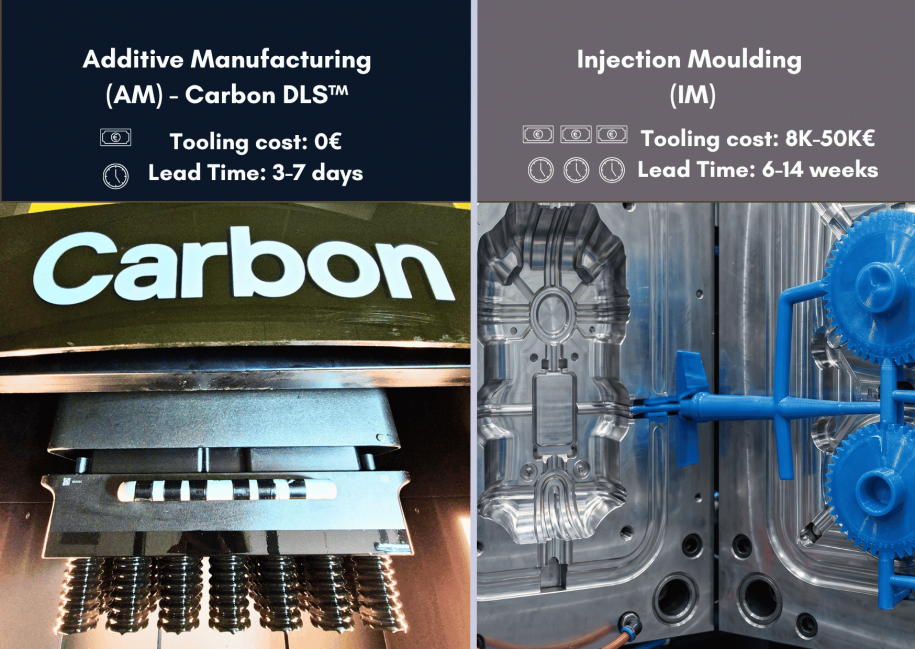
The fundamental difference between 3D printing and injection moulding is not technology — it is cost structure. Injection moulding carries a large fixed cost upfront (the mould), then a very low variable cost per part. 3D printing has zero tooling cost, but a higher, and relatively flat, cost per part across volumes.
This creates a cost curve — but one that looks very different depending on your sector, part geometry, and how often you expect to revise the design. A footwear sole with 15 size variants behaves completely differently from a standard automotive bracket at the same volume. The decision tool below reflects that complexity.
Make-or-Buy Decision Tool
Answer six questions about your part and get a technology recommendation grounded in Prototek’s engineering experience across automotive, footwear, industrial automation, fashion, and aerospace.
3D Printing or Injection Moulding?
The right answer depends on your sector, volume, geometric complexity, and project maturity — not just the number of parts. This tool replicates the logic Prototek engineers apply in every technical consultation.
Real-World Cost Benchmarks
The numbers below are derived from Prototek’s production data across industrial sectors. They represent indicative ranges for medium-complexity parts (palm-sized, 50–200 cm³ volume).
HP Multi Jet Fusion — PA12
Carbon DLS — EPU / CE
Injection Moulding — PA / PP
3D Printing vs Injection Moulding | Key insight: At 1,000 units, HP MJF (PA12) and injection moulding often reach cost parity for medium-complexity parts — but Additive Manufacturing requires zero upfront commitment and allows design changes at any stage. For parts with annual volumes under 2,000 units, or with frequent design iterations, the total cost of ownership favours AM even when the per-part price appears higher.
Full Comparison: Beyond the Unit Price
A make-or-buy decision should never be based on per-part cost alone. The table below captures the full picture across the factors that matter to engineers and procurement teams.
| Decision Factor | 3D Printing (HP MJF / Carbon DLS) | Injection Moulding |
|---|---|---|
| Tooling cost | €0 — no mould required | €8,000–80,000+ upfront |
| Time to first part | 3–7 days | 6–14 weeks |
| Minimum order quantity | 1 unit | Typically 500–1,000+ |
| Design change cost | Zero — modify CAD, reprint | €2,000–15,000 mould rework |
| Geometric complexity | Internal channels, lattice, undercuts — no penalty | Draft angles, no undercuts, no internal voids |
| Part-to-part consistency | High (±0.2 mm typical) | Very high (±0.05–0.1 mm) |
| Material range | PA12, TPU, EPU, CE (epoxy), growing range | Very broad (any injection-grade polymer) |
| Inventory risk | On-demand — produce only what you need | MOQ forces excess stock |
| IP / data security | ISO 27001 certified (Prototek) | Varies by supplier |
| Optimal volume range | 1 to ~10,000+ units / year | 5,000 to millions / year |
When to Choose 3D Printing vs Injection Moulding— Decision Rules
Choose AM (MJF or Carbon DLS™) when:
- Annual volume is below 2,000–5,000 units for thermoplastic parts**
- The part is in an active development phase — design changes are likely
- Geometry is complex: internal channels, lattice structures, organic shapes
- You need parts within days, not weeks (NPI, spare parts, tooling)
- You want to eliminate inventory and produce on-demand
- You need customised or personalised parts (different sizes, configurations)
- You are consolidating multiple components into a single printed part
Choose Injection Moulding when:
- Annual volume consistently exceeds 5,000–10,000 units
- Part design is fully frozen — no design iterations expected
- Part geometry is simple, compatible with standard tooling
- You need materials not yet available in AM (PP, ABS in large volumes, transparent polymers)
- Unit cost is the only metric (long-run commodity production).
**Depending on the product, material, and technology, AM is also suitable for scalable batches of up to 10,000 units or more.
The hybrid approach: many Prototek customers use Additive Manufacturing for the first 500–2,000 units (validation phase, early market), then evaluate tooling investment once design is stable and volumes are proven. This avoids the risk of committing €20,000–80,000 to a mould for a product that may still change.
Frequently Asked Questions
1. At what quantity does 3D printing become more expensive than injection moulding?
2. Is 3D printing cheaper than injection moulding for small quantities?
3. What hidden costs does injection moulding have that 3D printing avoids?
4. Can 3D printed parts replace injection moulded parts in terms of mechanical properties?
5. How long does it take to get parts with 3D printing vs injection moulding?
Not sure which technology fits your part?
Prototek’s engineering team analyses your geometry, volume, and requirements — and gives you an honest cost comparison. ISO 9001 and ISO 27001 certified. Based in Italy, serving Europe.