


EPU PRO 90 Carbon 3d printing
EPU Pro 90
Carbon DLS™ 3D Printing:
High-Stiffness Elastomer for Durable Parts
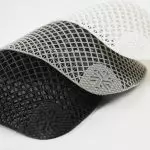
EPU Pro 90 3D printing is a Carbon DLS™ production process that uses a single-part, dual-cure elastomeric resin to manufacture stiff, durable components with an elongation at break of 440% and a Shore A hardness of 88. It is the higher-durometer counterpart to EPU Pro 50 within Carbon’s EPU Pro platform, engineered for lattice designs and end-use parts that require structural stiffness combined with elastomeric flexibility.
Prototek uses EPU Pro 90 to produce technical prototypes and serial production parts for footwear, seating, automotive, and industrial applications.
What Is EPU Pro 90?
EPU Pro 90 belongs to Carbon’s EPU Pro platform, a family of single-part, dual-cure elastomers designed to broaden the range of mechanical responses achievable in latticed and functional additive manufacturing parts.
Within the platform, this elastomeric resin is the stiffest formulation, intended for applications where structural rigidity, load-bearing capacity, and print strength are the primary design drivers — while still retaining the flexibility and energy return typical of an elastomer.
Because it is a single-part material, it removes the mixing step required by traditional two-part resins, simplifying both prototyping and scale-up to serial production.
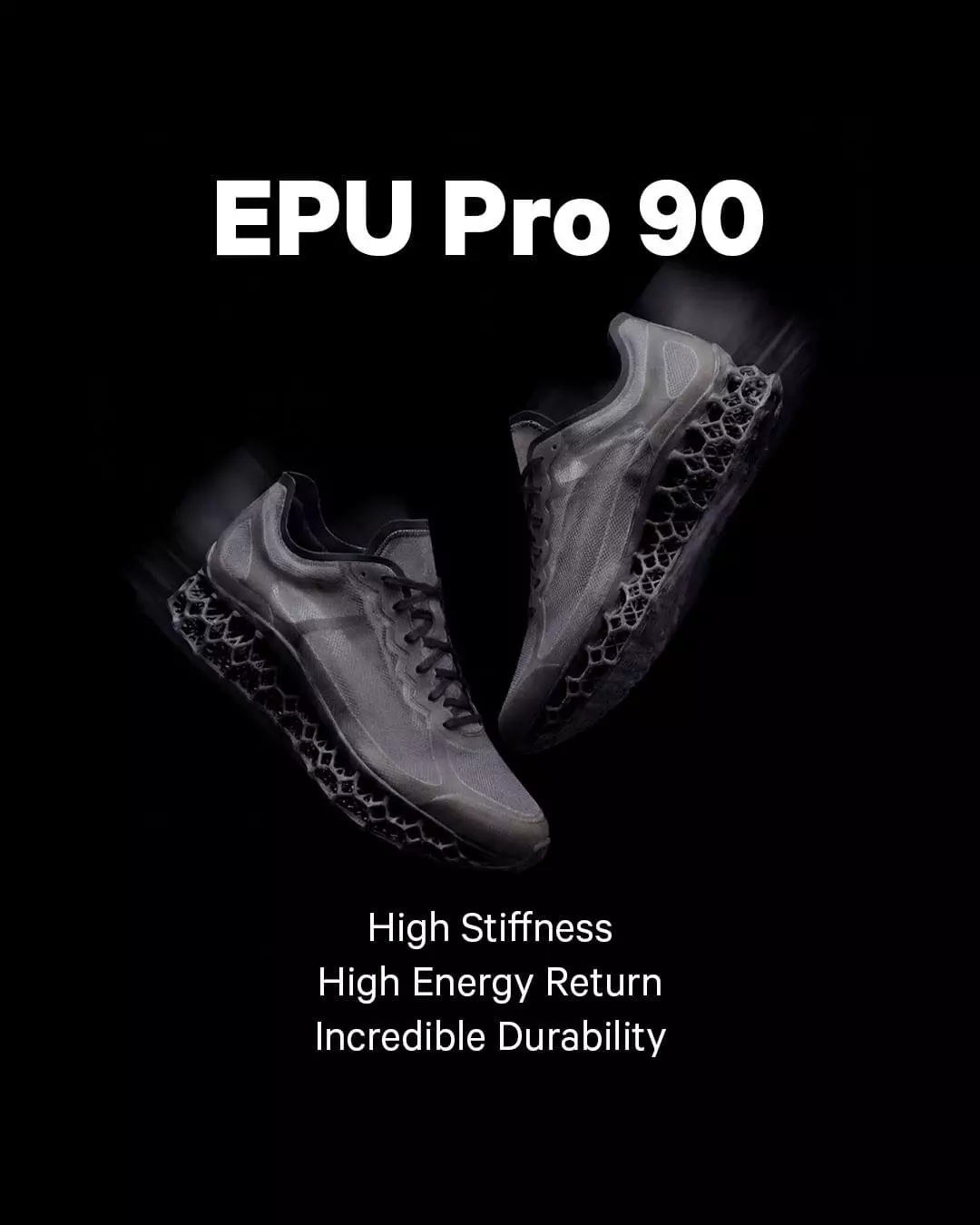
Single-Part, Dual-Cure: Why It Matters for Production
Two-part elastomers require precise metering and mixing before each print, adding labor, equipment requirements, and batch-to-batch variability risk.
EPU Pro 90, dispensed as a single liquid and cured through a UV plus thermal-bake process, offers:
- No manual mixing, reducing operator-dependent variability
- Extended pot life, allowing unused resin to be reclaimed after a print
- Compatibility with solvent-free post-processing and melt-processed workflows
- A more straightforward path from prototype to serial production volumes.
EPU Pro 90 Technical Properties
The table below summarizes the mechanical, thermal, and physical properties of EPU Pro 90, based on Carbon’s official technical datasheet.
| Property | Test Standard | EPU Pro 90 |
|---|---|---|
| Shore A Hardness | ASTM D2240 | 88 A (instant) |
| Elongation at Break | ASTM D412 | 440% |
| Tensile Modulus | ASTM D412 | 29 MPa (4200 psi) |
| Ultimate Tensile Strength | ASTM D412 | 22 MPa (3200 psi) |
| Tear Strength (0.8 mm) | ASTM D624 | 45 kN/m (260 lbf/in) |
| Glass Transition Temperature (Tg) | ASTM D4065 | -12 °C (10.4 °F) |
| Bayshore Resilience | ASTM D2632 | 32% |
| Compression Set (23 °C, 72h) | ASTM D395-B | 37% |
| Ross Flex (23 °C and -10 °C) | ASTM D1052 | > 100,000 cycles |
| Bulk Density | ASTM D792 | 1.11 g/cm³ |
These figures reflect parts processed and cured according to Carbon’s standard EPU Pro 90 workflow; actual performance depends on part geometry, orientation, and post-processing.
What Makes EPU Pro 90 Different from Standard Rubber or TPU?
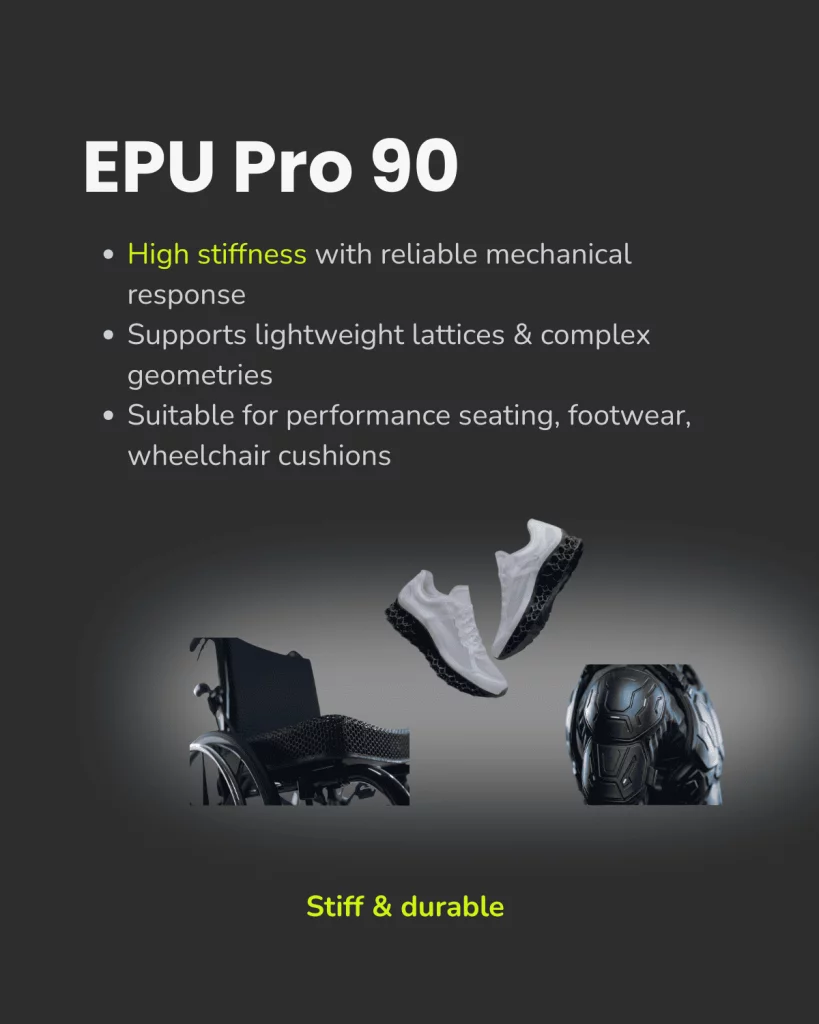
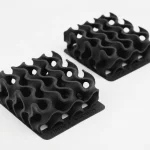
Compared to molded rubber or TPU, EPU Pro 90 allows engineers to combine a high Shore A hardness with complex internal lattice structures printed in a single part — a level of geometric freedom not achievable with conventional molding processes, and without the tooling costs and lead times that molded elastomers typically require.
How Does EPU Pro 90 Compare to Other Carbon Elastomers?
Within Carbon’s elastomer portfolio, EPU Pro 90 offers the highest durometer available, extending the platform’s range beyond earlier formulations.
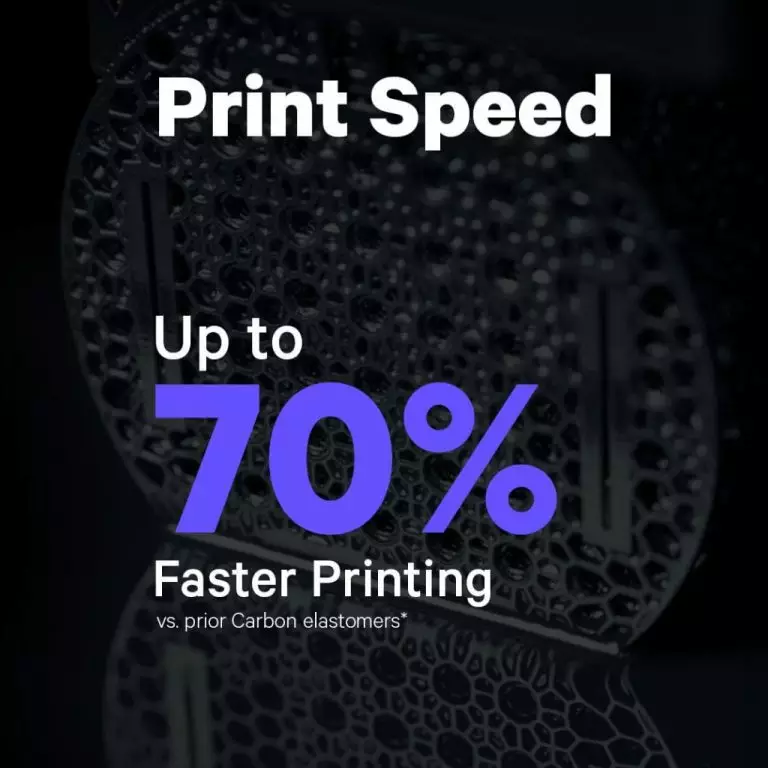
Like EPU Pro 50, it prints up to 70% faster than EPU 40 on printers with force feedback, with improved print strength across the durometer range.
Compared to energy-damping EPU 45 or bio-derived, energy-returning EPU 46, this stiffer resin is the reference choice when a project’s priority is structural rigidity and load-bearing capacity rather than damping behavior or bio-based content.
Applications of EPU Pro 90
Comfort and Performance Seating
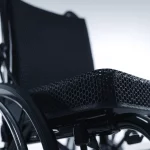
EPU Pro 90 supports the stiffer end of a cushioning system, enabling designs where structural support zones and softer cushioning zones are combined within the same latticed part, with control over weight distribution, breathability, and support.
Footwear Components
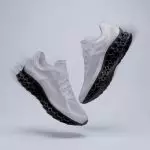
The material’s stiffness and print strength support lightweight footwear elements that require structural support alongside cushioning — for example, midsole zones needing more rebound and containment, finished with a distinctive matte aesthetic.
Automotive and Industrial Grips, Seals, and Handles
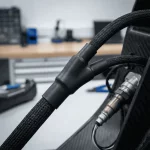
EPU Pro 90‘s higher print strength enables curved, load-bearing structures with a controlled, durable feel — relevant for grips, handles, and gasket or seal components used in automotive and industrial equipment where durability under repeated flexing is required.
Entertainment and Custom One-Off Parts
The extended pot life and workflow simplicity of EPU Pro 90 support the efficient production of custom, one-off components where a specific stiffness, fine surface detail, and a distinctive finish are required.
Why Choose Prototek for EPU Pro 90 3D Printing?
Prototek is a certified Italian additive manufacturing service bureau (ISO 9001, ISO 27001) specializing in Carbon DLS™ and HP Multi Jet Fusion production.
Producing consistent, high-durometer elastomer parts at scale requires precise control of dispensing, dual-cure processing, and post-cure conditions — an area where over 20 years of Additive manufacturing know-how and dedicated technical consulting support engineers from first prototype to validated series production.
Working with Prototek on EPU Pro 90 projects means:
- Dedicated technical consulting from prototype through serial production
- Production capacity to scale from a single part to thousands of units
- Certified quality and information security management systems (ISO 9001, ISO 27001)
- Design for Additive Manufacturing (DfAM) support to fully exploit lattice geometries and structural performance
- On-demand production that removes the need for warehouse stock.
Frequently Asked Questions About EPU Pro 90
What is the Shore A hardness of EPU Pro 90?
EPU Pro 90 has an instant Shore A hardness of 88 (89 after 5 seconds), making it the stiffest elastomer in Carbon’s EPU Pro platform.
Is EPU Pro 90 biocompatible?
Printed parts in EPU Pro 90 have met the requirements of ISO 10993-5 (cytotoxicity), ISO 10993-10 (skin sensitization), and ISO 10993-23 (irritation) testing conducted by an accredited third-party laboratory.
What is the elongation at break of EPU Pro 90?
EPU Pro 90 reaches an elongation at break of up to 440% (measured on 0.8 mm thickness samples per ASTM D412).
Can EPU Pro 90 be used for load-bearing lattice parts?
Yes. Its combination of high Shore A hardness, tensile strength, and print strength makes it suitable for structural lattice geometries that need to retain elastomeric flexibility.
How does EPU Pro 90 compare to other Carbon elastomers?
EPU Pro 90 offers the highest durometer in Carbon’s elastomer range and prints up to 70% faster than EPU 40 on printers with force feedback. It is the reference choice when a project prioritizes structural rigidity and load-bearing capacity, while EPU 45 (energy-damping) and EPU 46 (bio-derived, energy-returning) remain better suited when those specific behaviors are required.
How does EPU Pro 90 differ from EPU Pro 50?
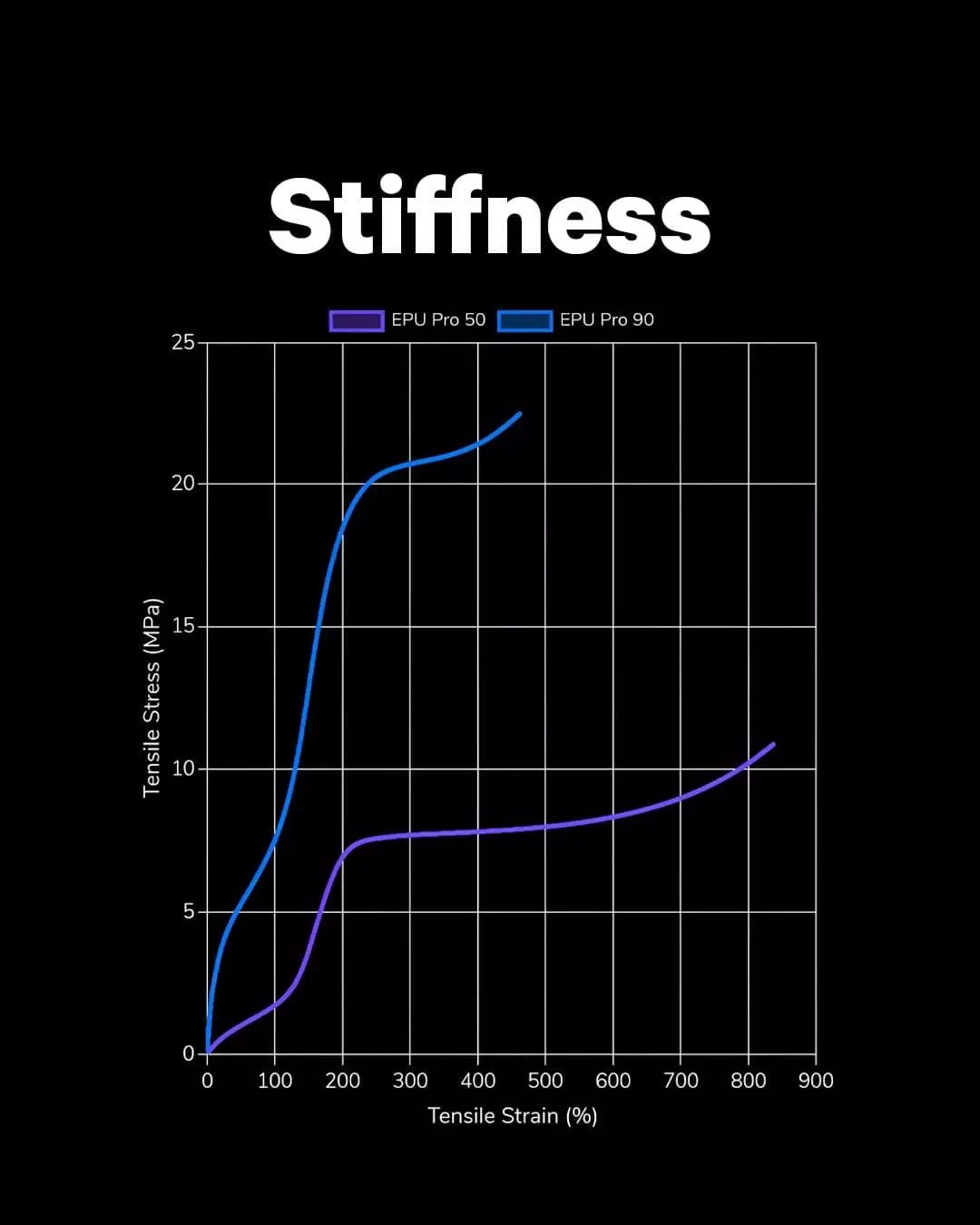
EPU Pro 90 is the stiffer, higher-durometer formulation of the EPU Pro platform (88A hardness, 440% elongation), while EPU Pro 50 is softer and more flexible (53A hardness, 820% elongation), suited to applications prioritizing softness and stretch.
Are you evaluating EPU Pro 90 for a structural or high-durability application?
Contact Prototek’s technical team for a dedicated consultation on material selection, part design, and production scalability.