


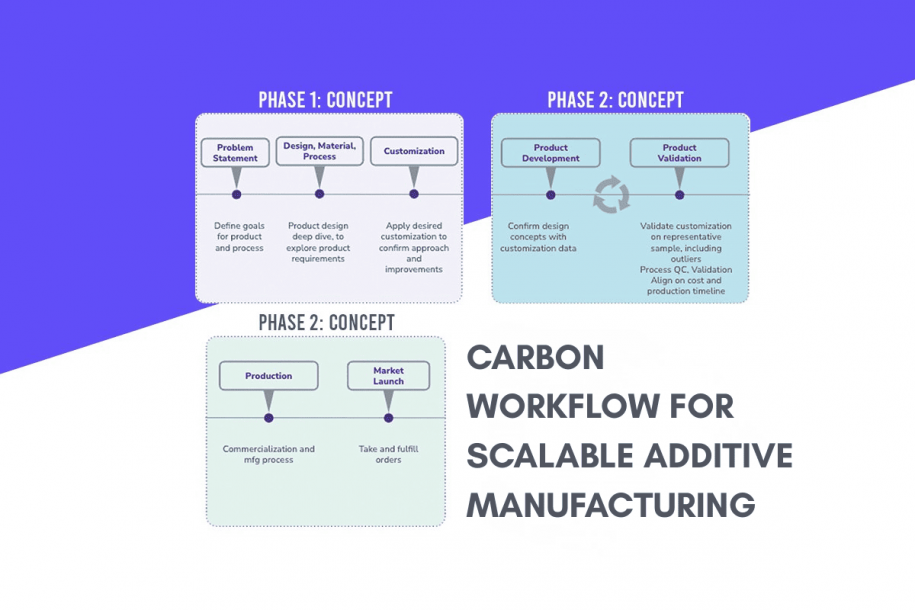
Discover our scalable additive manufacturing production workflow.
At Prototek, we take your initial concepts and develop them into high-performance functional parts through state-of-the-art industrial additive manufacturing.
Whether you need small batches or high-volume runs, our 3D printing manufacturing processes guarantee precision, certified materials, and repeatability.
Additive manufacturing production as a driver of manufacturing: from DfAM to series
Additive manufacturing production is no longer a workaround for low volumes or complex geometries. For R&D managers, product engineers and technical leads across Europe’s most demanding industries, it has become a fully viable manufacturing strategy, one that removes tooling constraints, eliminates spare part inventory, and compresses time-to-market from weeks to days.
If you’re evaluating additive manufacturing as a production method — not just for prototyping — you’ve likely asked:
- Can I move from functional prototype to serial production without switching technology or supplier?
- Is it realistic to eliminate spare part stock without risking downtime?
- Does DfAM actually improve component performance, or is it just geometric optimisation?
This article answers those questions directly, with technical depth and real-world industrial applications.
What is DfAM and why does it determine the success of additive manufacturing production?
DfAM — Design for Additive Manufacturing — is the design methodology that makes scalable AM production economically viable. It means exploiting the geometric freedom of 3D printing from the earliest stages of product development, rather than retrofitting a conventionally designed part into an AM process.
The distinction from classical design-for-manufacturing is fundamental:
| Traditional Design | DfAM |
|---|---|
| Tooling and molding constraints | Total geometric freedom |
| Process optimization | Functional optimization |
| Slow and expensive iterations | Rapid digital cycles |
| Assembled components | Parts consolidated into a single piece |
With DfAM, engineers can design internal lattice structures that reduce mass without sacrificing stiffness, conformal cooling channels, variable-density zones and organic geometries that are simply not achievable through CNC machining or injection moulding.
As leading AM researchers have noted, DfAM adds engineering value precisely by enabling lightweighting, part consolidation, mass customisation and on-demand production, overcoming the higher per-unit cost of AM compared to traditional methods, and making the switch to serial additive manufacturing production genuinely competitive.
How additive manufacturing production eliminates spare part inventory costs
One of the highest-ROI applications of serial additive manufacturing is on-demand spare parts production — and it’s where the economic argument is clearest.
The traditional spare parts model forces manufacturers to:
- produce minimum batch quantities to justify tooling amortisation
- hold stock for months or years, with associated capital and warehouse costs
- manage obsolescence risk and disposal of excess inventory
- sustain fixed costs regardless of actual demand
With additive manufacturing production, the model inverts entirely: the digital file is the warehouse.
When a spare part is needed — one unit, ten, several hundred, or thousands — the component is produced on demand, in certified materials, to the exact specification of the original. No stock. No obsolescence. No frozen capital.
This model is already operational across European industrial sectors:
- Automotive and motorsport: low-volume parts for out-of-production vehicles, jigs, fixtures and support components
- Industrial machinery and automation: production line spares, special tooling, custom fixtures produced to order
- Marine and aerospace: certified components for critical environments, manufactured on commission.
Carbon DLS™: the technology for functional additive manufacturing production
Carbon DLS™ (Digital Light Synthesis™) is among the most advanced polymer additive manufacturing technologies available today for functional, end-use components in epoxy and elastomeric resins.
Unlike conventional stereolithography, Carbon DLS™ uses light and oxygen to drive continuous resin polymerisation, producing parts with:
- Isotropic mechanical properties — consistent in all directions, unlike FDM
- Smooth surface finish — no visible layer stratification
- Certified materials — validated for industrial, medical and food-contact applications
- Scalable production workflow — from 1 part to thousands, within the same digital process
Which Carbon DLS™ materials does Prototek work with?
Prototek operates across the full Carbon resin library, including:
- EPX (82, 86FR, 150) — high-rigidity epoxy resins for structural components, including flame-retardant grades
- RPU (70, 130) — tough, ductile resins with high-temperature and impact resistance
- EPU (40, 41, 43, 45, 46) — polyurethane elastomers for flexible, impact-resistant parts
- UMA 90 — rigid material for functional prototypes requiring tight dimensional tolerances
- LOCTITE IND405 — rigid resin with transparent matte finish, high elongation and impact resistance.
All materials are certified and tested, with full technical datasheets available on request.
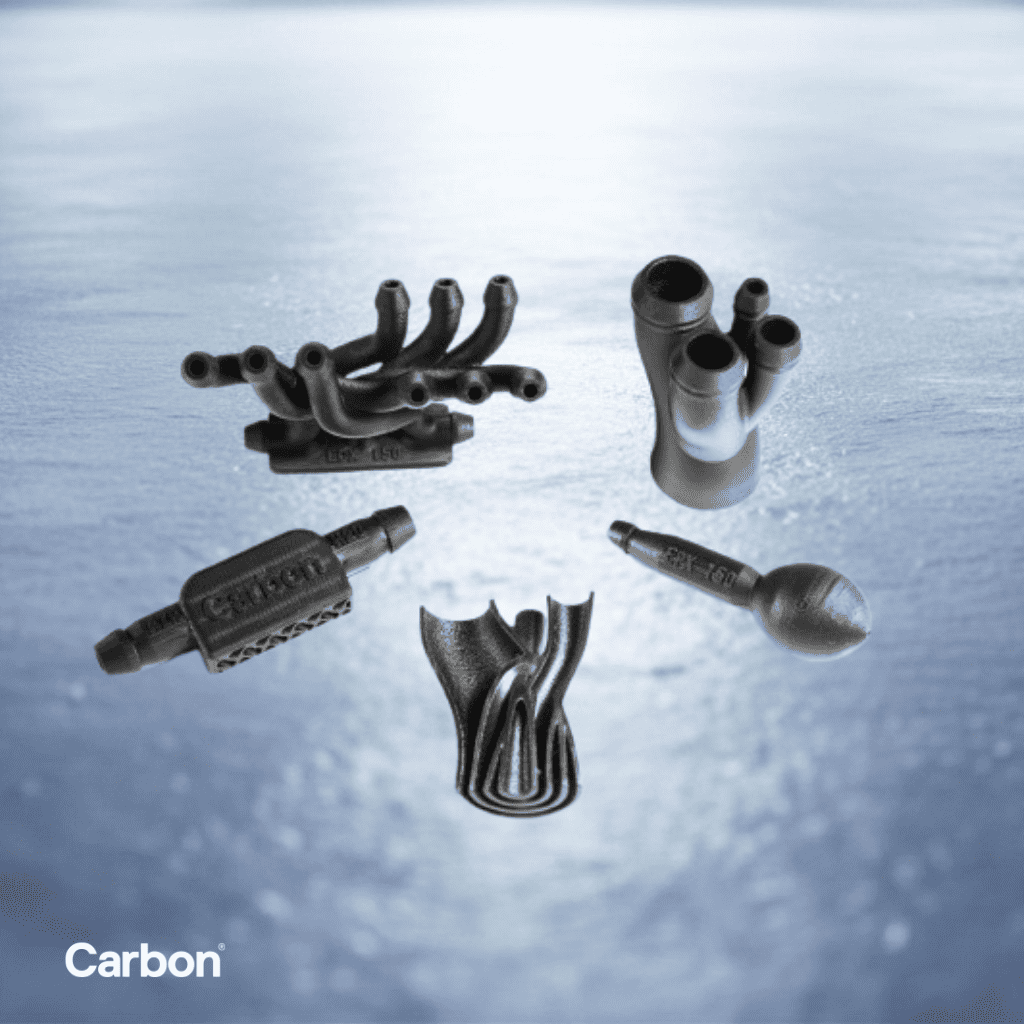
Industrial Additive Manufacturing: from Functional Prototypes to Certified Serial Production
Industrial additive manufacturing has fundamentally changed the economics of low-to-medium volume production across Europe’s most demanding sectors. Unlike desktop or prosumer 3D printing, industrial additive manufacturing operates within a framework of certified materials, traceable processes, and repeatable mechanical performance; the non-negotiable requirements of automotive, aerospace, medical device, and industrial automation supply chains.
Prototek’s industrial additive manufacturing infrastructure combines Carbon DLS™ and HP Multi Jet Fusion technologies with ISO 9001-certified production management, giving engineering and procurement teams a single partner capable of scaling from a validated prototype to a certified production batch without changing technology, supplier, or quality framework. Our industrial additive manufacturing service includes upstream DfAM consulting, material selection based on functional requirements, machine-level process control, and post-processing. All managed internally, with defined lead times and full dimensional traceability on every order.
For companies evaluating industrial additive manufacturing as a strategic alternative to injection moulding or CNC machining for specific components or product families, Prototek offers a free technical consultation to assess feasibility, unit cost, and time-to-production.
3D Printing Manufacturing: Replacing Traditional Processes Without Replacing Your Supply Chain
The shift to 3D printing manufacturing does not require a complete overhaul of your production strategy. It requires identifying the components, product families, or supply chain nodes where additive manufacturing delivers a measurable advantage over conventional processes, and integrating it precisely there.
Prototek’s 3D printing manufacturing service is designed for exactly this transition. Whether you are producing structural brackets that benefit from topology optimisation, elastomeric components that require complex internal geometries impossible to achieve with injection moulding, or low-volume spare parts that currently tie up capital in slow-moving inventory, our 3D printing manufacturing workflow provides a technically and economically viable alternative. With Carbon DLS™ for high-performance polymer components and HP MJF for high-volume thermoplastic production, we cover the two most relevant 3D printing manufacturing technologies for European industrial clients, under the same roof, managed by the same technical team, certified under ISO 9001.
The result is a 3D printing manufacturing partnership that reduces tooling investment, compresses iteration cycles, and gives your engineering team the geometric freedom to design components that actually perform better, not just components that are cheaper to produce.
Additive 3D Manufacturing as a Production Strategy: Beyond Prototyping
For many European industrial companies, additive 3D manufacturing still lives in the prototyping department; a tool for rapid iteration and concept validation, but not a serious candidate for serial production. That perception is now technically and economically outdated.
Modern additive 3D manufacturing platforms, specifically Carbon DLS™ and HP Multi Jet Fusion, the two core technologies in Prototek’s production facility, deliver mechanical properties, surface finishes, and dimensional tolerances that meet or exceed the requirements of functional end-use components in regulated industries.
Additive 3D manufacturing with Carbon EPX epoxy resins, for example, produces structural parts with isotropic mechanical behaviour and heat resistance comparable to engineering thermoplastics, while HP MJF with PA 12 delivers injection-moulding-equivalent performance for complex geometries at batch sizes from tens to thousands of units.
The strategic value of additive 3D manufacturing at production scale lies in what it removes from your cost structure: tooling investment, minimum order quantities, warehouse costs for slow-moving spare parts, and the lead time penalty of traditional manufacturing. Prototek’s role as your additive 3D manufacturing partner is to help you identify precisely where those removals are most impactful, and to execute the transition with the technical rigour your application demands.
3D Printing On Demand Manufacturing: Eliminate Inventory, Produce What You Need, When You Need It
3D printing on demand manufacturing is not a compromise between quality and flexibility. It is a production model that eliminates the structural inefficiencies of traditional batch manufacturing while maintaining certified, repeatable component quality. For industrial companies managing long product lifecycles, geographically distributed maintenance operations, or low-rotation spare parts with high criticality, on demand 3D printing manufacturing removes the single most expensive constraint in conventional supply chains: the obligation to produce before demand is confirmed.
With Prototek’s 3D printing on demand manufacturing service, your digital file is your warehouse. When a component is required — one unit, fifty, or five hundred — it is produced in the certified material and to the exact specification of the validated original, with a lead time measured in days rather than weeks.
Our on demand manufacturing workflow is built on Carbon DLS™ and HP MJF platforms that maintain consistent process parameters across every production run, ensuring that a part produced today is dimensionally and mechanically identical to one produced six months ago.
The industries already operating 3D printing on demand manufacturing through Prototek include automotive and motorsport, industrial machinery, where production line spares must be available without minimum order commitments, and marine and aerospace, where certified on demand 3D printing eliminates the obsolescence risk of slow-moving critical inventory.
Carbon Design Engine: the DfAM software behind scalable production
A critical element of the Carbon DLS™ ecosystem is Carbon Design Engine — the DfAM software developed by Carbon to automate and optimise part design for additive manufacturing production.
Design Engine integrates with standard CAD file formats, allowing design teams to work within their existing tools while accessing:
- Automated lattice generation — lightweight internal structures calibrated for load and stiffness requirements
- Variable density and rigidity zones — within a single printed component
- Print feasibility validation — resolved upstream, before committing to production runs
The result: engineering teams focus on product innovation rather than production constraints.
The measurable advantages of DfAM in serial production
Applied correctly within an additive manufacturing production workflow, DfAM delivers advantages that traditional manufacturing cannot match:
- Total part customisation — each component can be unique, adapted to individual users or specific assemblies, at no additional cost per variant.
- Tooling cost elimination — no moulds, no dies, no minimum order quantities.
- Faster iteration — digital design cycles measured in days, not weeks.
- Weight and material optimisation — lattice structures and topology optimisation reduce mass while maintaining structural performance.
- Sustainability — additive manufacturing production generates significantly less material waste than subtractive CNC processes; powder-based technologies like MJF enable recycling of up to 80% of unused material per build cycle.
HP Multi Jet Fusion and PA 12: additive manufacturing production at industrial scale
For higher volumes and geometrically complex parts in thermoplastic materials, Prototek uses HP Multi Jet Fusion (MJF) with nylon PA 12 (polyamide 12) and TPU.
MJF is engineered specifically for serial production: no support structures are required, parts nest in 3D within the build volume, and each cycle can produce dozens or hundreds of components simultaneously, with consistent mechanical properties throughout the batch.
Why PA 12 with MJF is the material of choice across automotive, footwear, fashion and mechanical component manufacturing:
- Mechanical performance comparable to injection-moulded thermoplastics
- Homogeneous surface finish, ready for painting or surface treatment
- Certified biocompatibility (ISO 10993) for skin-contact applications
- Dimensional stability across complex geometries and thin-wall sections
TPU with HP MJF adds controlled elasticity: ideal for soles, joints, gaskets, and shock-absorbing components, applications where Prototek partners with clients to develop high-performance components.
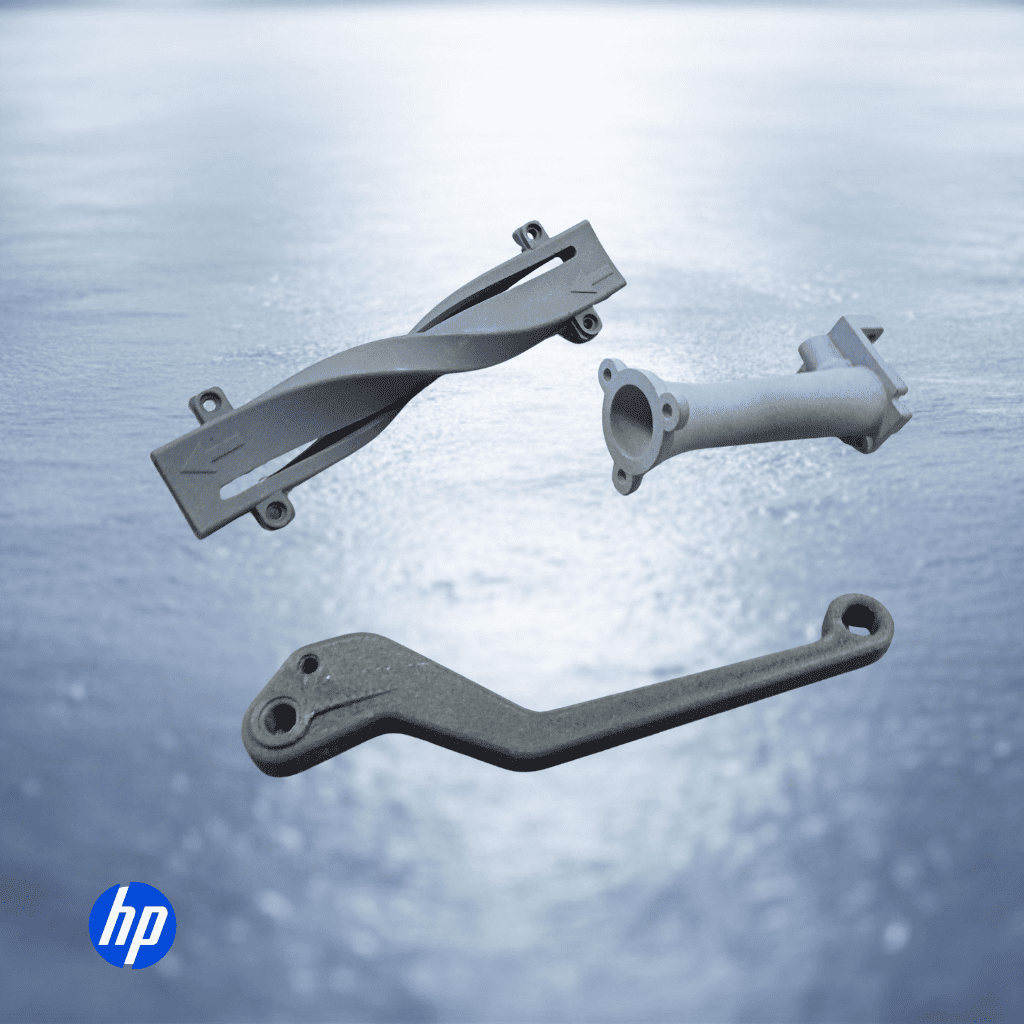
From prototype to certified series: the strategic value of a digital production workflow
The real advantage of additive manufacturing production is not purely technical — it is strategic and financial.
Integrating AM into both product development and spare parts management gives industrial companies:
- Reduced time-to-market — design iterations in days, not weeks; production launched without tooling delays.
- Elimination of tooling investment — no moulds, no minimum batch commitments, no setup costs.
- Scalable customisation — each part can differ from the next at zero additional unit cost.
- Progressive scalability — start with one part, scale to thousands within the same certified process and supply chain.
- Project security — Prototek operates under ISO 9001 (quality management) and ISO 27001 (data security), protecting both production consistency and IP confidentiality.
This workflow is already embedded in the development and production cycles of companies such as Selle Italia, Cantiere Filippi and OMNIA Technologies — organisations where the margin between winning and losing is measured in grams, millimetres and days.
Additive manufacturing production: FAQs from R&D and engineering teams
1.Can DfAM be applied to existing components, or only to new designs?
Both. DfAM applies to components designed from scratch and to re-design for AM projects — existing parts redesigned to exploit additive manufacturing production. The process begins with a functional analysis of the original component: load paths, assembly constraints, surface and tolerance requirements. Redesign follows, optimised for the target AM technology and production volume.
2. How many parts can realistically be produced with industrial additive manufacturing?
There is no fixed ceiling. With HP MJF and Carbon DLS™, Prototek produces from single functional prototypes to batches of thousands of parts within weeks, maintaining certified dimensional consistency and mechanical performance across the full production run.
3. How do you guarantee repeatability across production batches?
Every production process is documented and traceable under ISO 9001 procedures. Print parameters, material lots and dimensional inspection data are standardised and recorded on every order, giving clients full traceability from file to finished part.
4. How does additive manufacturing production compare in terms of sustainability?
Additive manufacturing generates significantly less material waste than CNC machining and eliminates tooling, which carries substantial embodied energy and material cost. On-demand production for spare parts removes the environmental cost of warehousing and disposing of obsolete stock: a direct benefit for companies managing long product lifecycles or low-rotation components.
Why partner with Prototek for additive manufacturing production in Europe
Prototek is not a commodity 3D printing bureau. We are a technical production partner that enters projects upstream — at the DfAM and material selection stage — and stays engaged through to certified series production.
What sets us apart:
- Technical know-how — our team advises on technology selection, material suitability and DfAM optimisation before a single part is printed
- Scalable production capacity — from 1 part to thousands, under the same certifications and quality standards
- Leading technologies — Carbon DLS™ and HP Multi Jet Fusion, covering both polymer performance and volume scalability
- Data security — ISO 27001 certification protects your design files and project IP throughout the production process
- Reliable lead times — defined and respected, critical for product launch windows and production schedules with no margin for delay. We take care of our customers’ security works.
Conclusion: additive manufacturing production is ready for European industry
In 2026, the shift from prototyping to certified serial production with additive manufacturing is no longer a future scenario. It is already happening across automotive, aerospace, marine, industrial machinery, and consumer goods manufacturing in Europe.
Companies that integrate AM production now — into both product development cycles and spare parts logistics — are removing tooling bottlenecks, compressing lead times and building supply chain resilience that compounds over time.
The question is no longer “does additive manufacturing work for our application?” It is “are we already using it as effectively as our competitors?”
Contact us for a free technical consultation. We will assess your component or production requirement and propose the most effective solution in terms of technology, material, and unit cost, with no obligation.